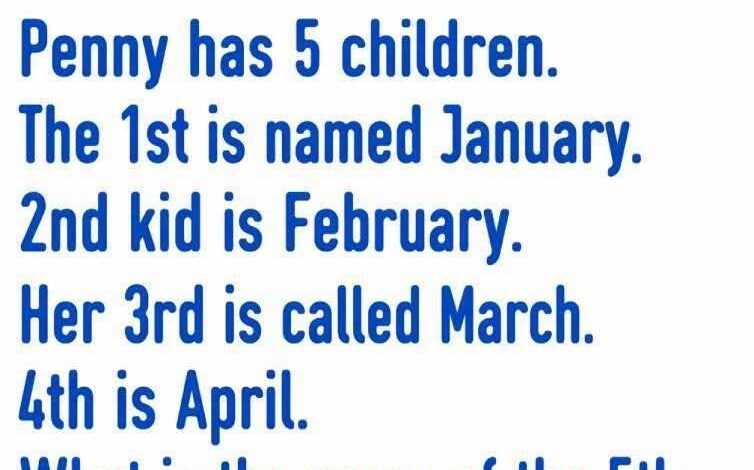
At first, the puzzle seems incredibly straightforward. Penny has five children, and the first four are named January, February, March, and April. Naturally, most people immediately assume that the fifth child must be named May because it continues the familiar sequence of calendar months. The pattern appears so obvious that many readers answer without thinking twice.
The riddle, however, is designed to test careful reading rather than pattern recognition. Instead of asking readers to simply complete the sequence, it encourages them to pay close attention to the exact wording. This subtle twist is what catches so many people off guard.
The opening sentence tells us, “Penny has five children.” This identifies Penny as the mother, not as one of the children. After that, the riddle names only four of the five children: January, February, March, and April. Although the monthly pattern strongly suggests that the next name would be May, the puzzle never actually says that the fifth child is named May.
Many people fall into this trap because the brain naturally looks for familiar patterns. Once readers recognize the sequence of months, they often stop paying attention to the rest of the wording and automatically fill in the missing piece themselves. The puzzle relies on this tendency, making it more of a reading-comprehension challenge than a test of logic.
There are several versions of this riddle circulating online. Some are written differently and ask, “What is the fifth child’s name?” In certain versions, people argue that the answer is “What” because it appears in the question itself. However, that interpretation depends entirely on how the riddle is phrased. Unless the wording specifically identifies “What” as a name, that conclusion isn’t supported by the text.
In this version, the fifth child’s name is simply never revealed. We know there are five children, but only four of them are identified. Since no name is given for the last child, there isn’t enough information to determine what that child’s name actually is.
The assumption that the answer is “May” comes only from recognizing the pattern, not from any statement in the riddle itself. While “May” feels like the obvious choice, it remains an educated guess rather than a confirmed fact. The puzzle intentionally leaves that final detail unstated, encouraging readers to separate what is explicitly written from what they naturally assume.
The most accurate conclusion, based solely on the information provided, is that the fifth child’s name is unknown. The riddle succeeds because it tempts readers to rely on expectation instead of evidence, reminding us that careful reading is often more important than spotting a familiar pattern.