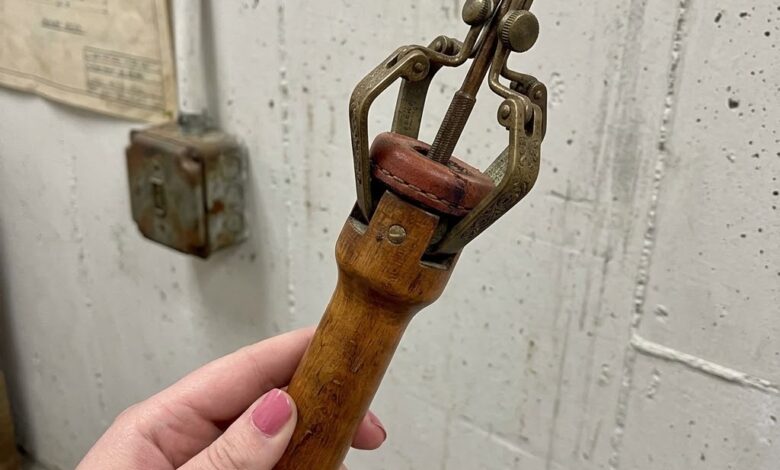
The Mysterious Farm Tool That Once Protected Dairy Cows
Hidden beneath years of dust and forgotten clutter in an old farm building, a strange wooden-handled instrument was discovered.
At first glance, there was nothing remarkable about it.
There was no name stamped across the handle.
No instruction manual nearby.
No obvious explanation for the unusual shape.
To someone living today, it could easily be mistaken for a broken piece of machinery or an obscure farming implement whose purpose had been lost generations ago.
But the object had once served a very specific purpose.
It was associated with the early days of mechanical dairy milking, when farmers were beginning to replace traditional hand-milking with machines.
The transition brought enormous advantages. Mechanical milking could save time, reduce physical labor, and make it possible to manage larger herds more efficiently.
But early machines came with their own problems.
One particularly important component was the rubber liner fitted inside the teat cup.
The liner was designed to create a softer interface between the machine and the cow. Rather than allowing the sensitive teat to come into direct contact with the hard metal cup, the rubber lining provided a flexible surface during the milking process.
The trouble was that early liners were not always as perfectly formed as the modern versions we know today.
Many were essentially rubber tubes that required careful preparation before they could be used.
The edge of the rubber needed to be shaped properly.
If it was uneven, poorly expanded, or improperly fitted, it could create uncomfortable pressure against the animal.
Repeated exposure to a badly prepared liner could potentially result in irritation, pinching, abrasions, or other forms of discomfort.
For a farmer, the problem might have looked like a minor mechanical issue.
For a dairy animal experiencing it repeatedly, however, it could become a serious welfare concern.
That is where the mysterious hand tool became useful.
A Small Tool for a Very Specific Problem
The device was known as an “Écarteur de tétine de trayeuse,” a French term referring to a teat-cup liner expander.
Its design was relatively simple.
A wooden handle allowed the operator to hold the tool securely, while the working end was designed to help spread or shape the rubber liner.
Instead of trying to manipulate thick rubber by hand, the farmer could use the tool to carefully open and form the end of the liner.
The objective was straightforward: create a smoother and more suitable opening so the liner could be fitted correctly inside the teat cup.
It was not a spectacular invention.
It did not have an engine.
It did not automate the milking process.
It did not look like the kind of machine that would become famous.
But it addressed a practical problem that farmers encountered during the early development of mechanical milking.
And practical problems are often where some of the most interesting inventions begin.
When Machines Were Still New
The arrival of mechanical milking equipment represented a major change in agricultural life.
For generations, farmers had relied on people to milk cows manually. The process required considerable time and physical effort, particularly on farms with many animals.
Mechanical systems promised to change that.
Instead of relying entirely on human hands, machines could perform much of the repetitive work.
But introducing machinery into a biological process was complicated.
The equipment had to interact with a living animal while maintaining proper hygiene and allowing milk to be collected efficiently.
Every component mattered.
Hoses had to remain clean.
Metal parts needed inspection.
Rubber liners required maintenance and replacement.
Connections had to fit correctly.
And anything that came into contact with the animal or milk needed careful attention.
A seemingly insignificant rubber edge could therefore become an important part of the overall system.
Why the Rubber Liner Mattered
The teat-cup liner was one of the most important points of contact between the machine and the cow.
During operation, the liner did not simply sit motionless around the teat. It was part of a system involving vacuum and pressure changes that helped extract milk.
Because the component was flexible and repeatedly exposed to mechanical forces, its condition mattered.
A liner that was worn, damaged, incorrectly installed, or improperly shaped could interfere with proper operation.
Farmers therefore had to pay attention not only to the machine itself but also to the small replaceable components that made the machine usable.
The old expander belonged to this maintenance culture.
It was essentially a specialized workshop tool for preparing one small but important part of the milking system.
Progress Often Begins With Small Problems
What makes this forgotten tool particularly interesting is what it represents.
Technological progress is often portrayed as a sequence of dramatic inventions.
A new engine appears.
A revolutionary machine is introduced.
A factory adopts a new production method.
But real technological progress is usually much messier.
People encounter small problems.
They modify equipment.
They develop specialized tools.
They improve materials.
They change manufacturing techniques.
Then another improvement makes the previous solution unnecessary.
The teat liner expander is a perfect example of this process.
It existed because the available rubber components were not yet as precisely manufactured as later versions.
As manufacturing technology improved, rubber liners could increasingly be produced with consistent dimensions and properly formed edges.
The need for farmers to manually shape them gradually declined.
And Then the Tool Became Obsolete
There was no dramatic moment when the world officially declared the tool obsolete.
It simply became less necessary.
New generations of liners arrived from manufacturers already formed to the appropriate shape.
Farmers could install the replacement components without needing the same specialized preparation.
The wooden-handled expanders that had once been useful were gradually pushed aside.
Some remained in workshops.
Others ended up in barns.
Some were placed in drawers with old tools.
Eventually, many were discarded.
And those that survived became historical curiosities.
Years later, someone could find one beneath a pile of forgotten equipment and have absolutely no idea what it was.
Without its original context, the object appears almost meaningless.
A Snapshot of Agricultural History
That is what makes old tools so fascinating.
They preserve evidence of problems that modern people rarely have to think about.
Today, a molded rubber component may look completely ordinary.
We simply expect it to arrive from the manufacturer ready to use.
But earlier generations often had to work with materials that were less standardized.
Farmers had to understand their machinery and make adjustments themselves.
They became mechanics, maintenance workers, operators, and problem-solvers all at once.
The small expander reflects that period.
It represents a time when mechanical milking was still developing and farmers were learning how to make increasingly sophisticated equipment work reliably in real-world conditions.
More Than Just an Old Piece of Metal and Wood
The tool may look insignificant compared with a tractor, combine harvester, or modern milking system.
But its story is a reminder that useful technology does not always have to be impressive in appearance.
Sometimes the most valuable invention is the one that solves a problem nobody else notices.
A small adjustment can prevent discomfort.
A better-fitting component can improve a process.
A simple hand tool can save time and reduce repeated problems.
And once manufacturing improves enough, that tool may disappear completely.
The Strange Object With a Forgotten Purpose
Imagine discovering the device today.
You pick it up from an old barn floor.
The wooden handle is worn smooth from years of use.
The metal has aged.
There is no label explaining its purpose.
It looks almost like a tool from another world.
But once its history is understood, the object becomes much more interesting.
It was part of a period when agriculture was moving from traditional methods toward mechanized production.
It belonged to a time when farmers were adapting machinery to the needs of living animals.
And it existed because even the most advanced new machines could still have small imperfections that required human solutions.
Eventually, better materials and manufacturing methods solved the problem more efficiently.
The specialized tool was no longer necessary.
But its disappearance does not make it meaningless.
Quite the opposite.
Its survival gives us a glimpse into the everyday challenges that accompanied technological change.
The Forgotten Lesson of the Little Expander
The story of this wooden-handled instrument illustrates an important truth about innovation.
Progress rarely happens all at once.
It happens through countless small improvements.
Someone notices a problem.
Someone designs a tool.
Someone changes a material.
Someone improves a manufacturing process.
And eventually, an entire system becomes better.
Then the tools that helped make those improvements possible fade into history.
The next generation may never know they existed.
That mysterious object in the old barn was therefore more than an unusual piece of farm equipment.
It was a small piece of agricultural history.
A reminder of the early challenges of mechanical milking.
A glimpse into the practical knowledge farmers once needed to maintain their equipment.
And an example of how an invention can be important for years before quietly disappearing.
Today, most people might walk past it without giving it a second look.
But behind its worn wooden handle and strange metal shape is a story about machines, animals, farmers, materials, and the gradual evolution of technology.
It never needed to change the world.
It only needed to solve one particular problem.
And for a time, that was enough.