Left With a Field of Useless Stone — She Built the Warmest House in the County
The first thing people said about the land was that it could not be farmed.
The second thing they said was worse.
“It can’t even keep a house standing.”
When Eleanor Whitaker stepped down from the wagon in the winter of 1883, the wind cut through her coat like a knife. Snow stretched across the hills of western Montana, hard and endless beneath a gray sky. Ahead of her sat seven acres of rocky ground littered with stone so thick the earth barely showed between them.
And at the center of it all stood a rotting log cabin with a roof collapsed under old snow.
Her husband had left her that cabin.
Or rather, he had left her everything no one else wanted.
Three months earlier, Samuel Whitaker had died beneath a logging cart when a frozen wheel snapped on an icy slope. He had been a decent man, but a dreamer, always believing the next season would bring fortune. Instead, debts swallowed nearly everything they owned. The fertile valley land was taken by the bank within days.
Only the “stone field” remained.
Nobody in Bitter Creek County wanted it.
The soil was poor. The winters were brutal. The hillside caught every northern wind. The nearest town sat twelve miles away by rough trail. Most men said even wolves avoided the place.
So when Eleanor arrived alone with a mule, a wheelbarrow, and her old brown dog Huck, the townsfolk pitied her before they laughed at her.
“She’ll be gone before spring.”
That became the common bet at the general store.
Eleanor heard it herself the first time she entered town for supplies.
Old Mr. Pritchard leaned against the stove and muttered loudly enough for everyone to hear.
“A widow alone on stone ground? Poor thing’ll freeze herself stiff.”
The men chuckled.
Eleanor said nothing.
She simply bought nails, lamp oil, and a secondhand hammer.
Then she returned to the hill.
That first night in the cabin nearly killed her.
Wind screamed through cracks in the logs. Snow drifted across the floorboards. Huck curled against her chest beneath three blankets while Eleanor fed broken chair legs into the tiny iron stove.
At midnight, she woke shivering so violently her teeth bled where they struck together.
She stared through the darkness at the collapsing walls and understood something terrifying.
If she stayed in this cabin, she would die before spring.
Most people, standing in her boots, would have packed the wagon by morning.
But Eleanor had nowhere left to go.
And somewhere beneath her fear was a small, stubborn ember of anger.
All her life, men had spoken as if warmth came only from money.
As if comfort belonged only to large farms and fine lumber houses.
As if survival itself belonged to men.
Eleanor rose before dawn, wrapped a scarf around her face, and walked outside into knee-deep snow.
The land looked hopeless.
Stone everywhere.
Gray stone. Jagged stone. Massive buried slabs poking through frozen drifts.
Then a strange thought came to her.
If the field was worthless because of the stone…
Why not build with it?
For a long moment she simply stood there while snowflakes gathered on her lashes.
Back in Ohio, her father had once worked beside Irish masons building railway bridges. Eleanor remembered watching them shape rock with careful hands. She remembered thick walls that stayed cool in summer and warm in winter.
Stone held heat.
Stone blocked wind.
Stone endured.
And this cursed land had more stone than anything else.
By noon, she had begun.
The work was brutal.
Eleanor hauled rock with frozen fingers until her shoulders burned raw. She used the wheelbarrow until one wheel cracked. She dug through snow for flat foundation stones while Huck followed close behind.
Every night she collapsed beside the stove too tired to eat properly.
Still, the walls slowly rose.
At first, people came only to mock her.
Travelers stopped along the road and stared at the widow stacking stones in the snow like a madwoman.
One rancher laughed openly.
“You planning to build a castle, Mrs. Whitaker?”
“No,” Eleanor replied without looking up. “Just a house that survives winter.”
The rancher rode away grinning.
But two weeks later, during a brutal cold front, he returned.
This time he was not smiling.
His youngest boy had nearly frozen when wind tore through their drafty cabin walls.
Meanwhile, smoke rose steadily from Eleanor’s half-finished stone structure.
“How’s it warmer in there already?” he asked.
Eleanor wiped mortar from her gloves.
“Because stone remembers heat.”
The rancher frowned as though she’d spoken another language.
By January, the house had taken shape.
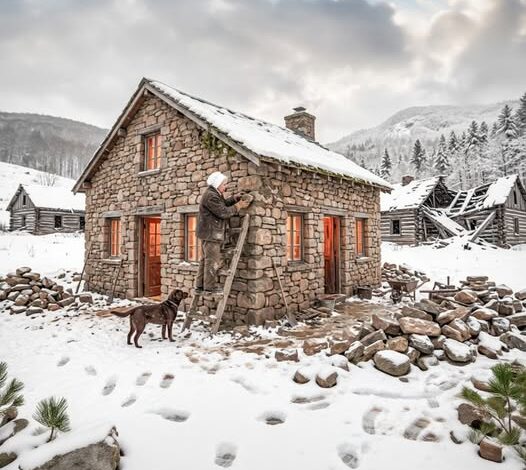
It was small but sturdy, built against the hillside where the earth shielded one side from the wind. Eleanor packed gaps with clay and straw. She built thick walls nearly two feet wide. She positioned narrow windows to catch southern sunlight during the day.
At night, the stone absorbed heat from the fireplace and released it slowly back into the rooms.
For the first time since Samuel’s death, Eleanor slept warm.
Word spread through the county.
People began visiting under excuses.
A farmer came claiming he needed directions.
A woman arrived asking to borrow salt.
Another family stopped after “getting lost.”
But the truth was always the same.
They wanted to step inside the stone house.
And every single visitor reacted the same way.
Silence.
Outside, the Montana winter clawed at cheeks and fingers. Inside, the air felt steady and gentle, carrying the scent of pine smoke and bread.
Children removed gloves in disbelief.
Men stood near the walls touching the stone.
Women stared at Eleanor as if seeing her for the first time.
One evening, Mrs. Callahan whispered, “It feels like… home.”
That nearly made Eleanor cry.
Because for months she had felt invisible.
Not hated.
Not loved.
Simply dismissed.
A widow with useless land.
Yet here, in the warm glow of her stone house, people suddenly listened when she spoke.
By February, the county suffered one of the harshest winters in decades.
Snow buried fences. Livestock froze standing upright in fields. Three cabins collapsed under heavy drifts.
Then came the blizzard.
The storm struck at dusk with screaming wind that erased the horizon. Snow hammered Bitter Creek County for nearly twenty hours without pause.
Families trapped in weak cabins panicked as temperatures plunged.
Near midnight, frantic knocking rattled Eleanor’s door.
She opened it against shrieking wind and found the Haskins family nearly frozen—mother, father, and two little girls wrapped in blankets crusted with snow.
“Our roof’s gone,” Mr. Haskins gasped. “Please.”
Eleanor pulled them inside immediately.
Then another knock came.
And another.
By dawn, seventeen people crowded inside the stone house.
Children slept on rugs beside the fire. Women cooked soup from Eleanor’s pantry. Men stomped snow from boots and stared in amazement at walls that neither shook nor leaked despite the storm raging outside.
The old cabin nearby finally collapsed completely before sunrise.
Everyone heard it happen.
A long cracking groan beneath the wind.
Then silence.
Mr. Pritchard—the same man who had mocked Eleanor in town—looked toward the sound and quietly said, “If we’d stayed in our homes tonight… some of us wouldn’t have seen morning.”
Nobody answered him.
They didn’t need to.
The truth sat all around them in warm stone walls.
After the storm passed, everything changed.
People no longer called it the stone field.
They called it Whitaker Hill.
Men who once laughed now asked Eleanor for advice.
“How thick should the walls be?”
“What mortar mix did you use?”
“Does southern light really matter that much?”
Eleanor answered every question patiently.
Spring arrived slowly.
Snow melted into streams around the hillside, revealing countless gray stones beneath the earth like buried treasure.
For the first time in her life, Eleanor saw beauty in them.
That summer, three new stone houses rose across the county.
Then five more.
Families began building root cellars lined with rock. Barn foundations improved. Fireplaces burned more efficiently.
Even the church added a stone gathering hall for winter meetings.
People said Bitter Creek survived colder seasons after that.
But what truly changed was harder to measure.
Before Eleanor, the county believed hardship had to be endured.
Drafty homes.
Frozen floors.
Children sleeping in coats.
People accepted suffering because it was familiar.
Eleanor challenged that without ever intending to.
Not through speeches.
Not through wealth.
But through stubbornness, observation, and work.
She simply looked at a field everyone hated and asked a different question.
Years later, travelers passing through Montana often stopped at Whitaker Hill.
The stone house became known across the region.
Not because it was large.
It wasn’t.
Not because it was luxurious.
It certainly wasn’t that.
But because people remembered how it felt to enter during winter.
Warm.
Solid.
Safe.
By then Eleanor’s hair had silvered at the temples. Huck had long since died and rested beneath a pine tree overlooking the valley. Children she once sheltered during the blizzard returned as grown adults with families of their own.
One December evening, a young newspaper writer traveled from Helena to interview her.
He expected to meet some fierce frontier legend.
Instead, he found a woman kneading bread beside the fire while snow drifted softly beyond the windows.
The young man looked around in amazement.
“I’ve never felt a house hold heat like this,” he admitted.
Eleanor smiled faintly.
“The stones do most of the work.”
“But how did you know it would succeed?”
She paused at that.
Outside, winter wind brushed against the walls with a low hush.
“I didn’t,” she finally said.
“Then why try?”
Eleanor looked toward the window where the old collapsed cabin once stood years ago.
“Because sometimes,” she answered softly, “the thing people call worthless is only waiting for someone stubborn enough to use it differently.”
The writer printed those words in newspapers across Montana.
And slowly, the story spread far beyond Bitter Creek County.
People loved telling it because it sounded impossible.
A widow alone.
A useless field of stone.
A house warmer than any in the county.
But the people who truly understood the story were those who had stood inside during winter storms.
They knew the warmth came from more than fireplaces.
It came from refusal.
From grief transformed into labor.
From loneliness transformed into shelter.
From a woman who had every reason to abandon that frozen hillside—and instead built something lasting enough to change an entire community.
The old stone house still stood long after Eleanor Whitaker was gone.
Long after newer buildings rose in town.
Long after railroads expanded westward.
Children born decades later still heard stories about the blizzard shelter on Whitaker Hill.
Some claimed the house never felt cold no matter how harsh the winter became.
Others said if you placed your hand against the inner wall, you could still feel the warmth Eleanor first trapped there with her stubborn hands and tiny fireplace all those years ago.
Perhaps that part wasn’t true.
But this part certainly was:
Everyone who once mocked the widow eventually admitted the same thing.
The most valuable thing in Bitter Creek County had been hidden beneath their feet the entire time.
And the warmest house in the county had risen from what everyone else believed was useless stone.