Former Soldier Survives Brutal Eviction and Blizzard with Only His Dog by His Side

The first time they threw Eli Grayson out, it was with paperwork.
The second time, it was with men.
And the third time, winter tried to finish what the others had started.
By then, the only reason Eli was still alive was the dog.
It happened on a Thursday in late November, the kind of Montana afternoon when the sky went white before the snow even started, and every rancher, mail carrier, and bartender in Red Hollow knew bad weather was stalking the valley. The wind cut down from the Beartooth foothills sharp as sheet metal. The pines behind Eli’s cabin groaned. The porch boards shivered under his boots as he stacked the last armful of split wood by the door.
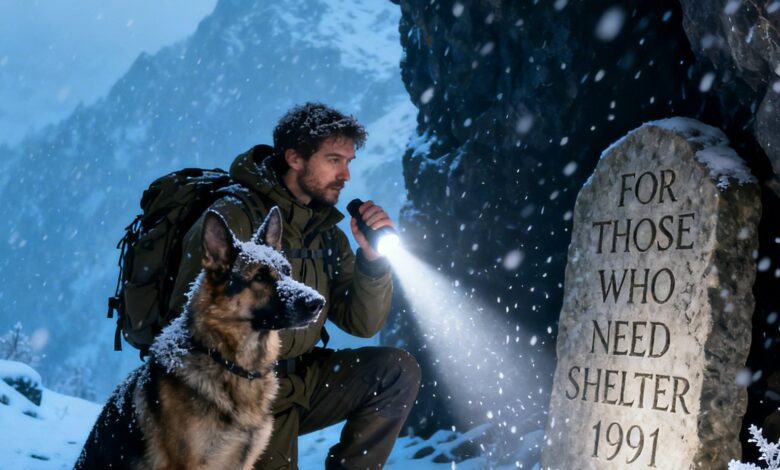
Boone stood in the yard, rigid and watchful, a scarred black-and-tan shepherd with snow beginning to collect along his back. He had once worked bomb detection beside Eli overseas. Now he watched roads, strangers, and lies with the same total focus.
A county SUV climbed the icy drive.
Eli knew before it stopped that the day had finally come.
Deputy Ray Mercer stepped out first, pulling his coat tighter around his stomach. Behind him came a man in a camel overcoat and polished brown boots that had never known honest mud. Travis Barlow. Developer. Smile like a billboard. Teeth too white for a place like Red Hollow.
And behind Travis came two men from Lockridge Recovery Services.
Eli stayed on the porch. Boone didn’t bark. He just moved closer to Eli’s leg.
“Afternoon,” Deputy Mercer said, not meeting his eyes.
Travis looked around the property like he already owned the mountain. “You were notified.”
“I was robbed,” Eli said. “That’s different.”
Mercer pulled off one glove and took out folded papers. “Final enforcement order. Property seizure due to delinquent tax liens and court-approved transfer. You’ve had time.”
“I never got the first notices.”
“They were mailed.”
“To an address I haven’t used in eight years.” Eli stepped down one stair. “Funny how county mail knows exactly where to find me when it wants my truck registration, but not when a man’s home is being stolen.”
Travis gave a sympathetic little sigh, the kind rich men practiced in mirrors. “No one’s stealing anything, Sergeant Grayson. This is development. Opportunity. The county needs jobs. The resort brings money. You were offered a fair price.”
“This was my father’s house.”
“And now,” Travis said, glancing at the paper in Mercer’s hand, “it isn’t.”
Boone let out a low growl.
One of the recovery men shifted uneasily. The other put a hand near the can of dog spray on his belt. Eli felt Boone’s tension travel through the leashless space between them like current.
“Don’t,” Eli said softly to the man.
Mercer cleared his throat. “You need to vacate, Eli.”
That name, spoken like they were still boys fishing the creek together, almost made Eli laugh.
He and Ray Mercer had gone to high school in the same town. Ray had stayed. Eli had joined the Army three weeks after graduation, then spent years in heat, dust, and war zones so far from Red Hollow they might as well have been different planets. He came back with scars, a Bronze Star he kept in a drawer, a dog nobody else wanted, and a cabin his father had left him in a handwritten will witnessed by two dead neighbors and a pastor who had since retired to Arizona.
He came back to a town that thanked veterans on Memorial Day and stepped over them by Christmas.
“I’ve got nowhere to go,” Eli said.
Travis shrugged. “There’s a motel in Gardiner.”
“With what money?”
“You should have taken the offer.”
The wind rose, flinging powder over the yard. Eli looked past them to the ridgeline above the property, where dark timber climbed toward rock and old snowfields. His father used to say the mountain had more mercy than men. At the time Eli had thought it was just another bitter line from a hard man. Standing there now, he wasn’t so sure.
Mercer unfolded the paper and read the formal language. Eli barely heard it. Possession. Transfer. Authority. Removal. Same cold words, same cold voices. Boone pressed against his knee and stared at Travis with a hatred so pure it almost felt holy.
When Mercer finished, Eli said, “So that’s it.”
“That’s it,” Travis said.
The recovery men started forward.
Eli moved first.
He wasn’t stupid enough to swing. He knew that was what they wanted—one veteran with a bad temper, one arrest, one story about instability to make the land transfer look clean. Instead he went inside and grabbed what mattered. Army rucksack. Heavy coat. Box of ammunition. His father’s old hunting knife. A coffee tin with cash. Photographs. Flashlight. Wool blanket. First-aid kit. Water canteen. Boone’s food bin.
By the time he came back out, the men were already carrying his life into the yard and leaving it in the snow.
A kitchen chair.
Two crates of books.
A lamp with a cracked green shade.
His mother’s quilt in a black trash bag.
He watched one of them drag out the cedar chest his father built the summer before Eli deployed the first time. The man dropped it off the porch like scrap.
“Careful,” Eli snapped.
The man looked at Travis.
Travis said, “It’s all debris after today.”
Something hot and dangerous rose in Eli’s throat.
Boone barked once—a hard, explosive sound.
Every man in the yard froze.
“Sergeant,” Mercer said quickly, nervous now. “Get your dog under control.”
Eli looked at Travis. “You come up my mountain, dump my dead mother’s things in the snow, and you want me under control.”
Travis smiled again, but there was strain in it now. “You were never built for civilized solutions, were you?”
It was meant to hit the old wound. The veteran. The damaged one. The man who came back wrong.
Eli shouldered his pack. “You’d be surprised what I was built for.”
Then he walked down off the porch with Boone at his side and left the men to his cabin.
He got halfway to the truck before Mercer called after him. “Keys.”
Eli turned.
“The truck,” Mercer said, embarrassed. “It’s attached to the property in the lien inventory until the appeal window closes.”
“That truck was paid off five years ago.”
“County wants it held.”
Travis said, “Procedure.”
Eli stared at him for a long second. Then he reached into his pocket, took out the keys to the 1998 Ford, and threw them into the snow at Travis’s expensive boots.
“Choke on procedure.”
He walked down the road with Boone and didn’t look back.
By dusk the storm hit full force.
The county road disappeared under blowing snow. Fence posts became ghosts. Eli’s duffel thumped against his spine, each step heavier than the last. Boone ranged ahead and circled back, never straying far, checking Eli every thirty seconds the way he had in Helmand Province when smoke, dust, and gunfire turned whole afternoons into blind panic.
They made it two miles before Eli admitted what his pride had known for the last half mile:
He was in trouble.
Red Hollow was behind him. Gardiner was too far. The nearest ranch house off the state road belonged to a man who’d sold to Travis Barlow last month. The temperature had dropped fast enough that his beard carried ice. The wind shoved at him sideways. He couldn’t feel two fingers on his left hand.
He stopped beside a stand of lodgepole pines and crouched, breathing hard.
Boone came to him immediately.
“Yeah,” Eli muttered, rubbing the dog’s neck. “I know.”
He could try the highway, but in a storm like this visibility vanished without warning. Men froze a hundred yards from shelter because they walked the wrong direction once. Eli had seen weather kill faster than bullets. Snow wasn’t dramatic. It was patient.
Boone lifted his head, ears high.
“What?”
The dog turned toward the timber uphill from the road.
“No.”
Boone looked back at him and whined—insistent, focused.
Eli knew that sound. Boone wasn’t nervous. He had found something.
The dog bounded upslope through the trees, then stopped and looked back again.
Eli swore under his breath. “You better not be chasing rabbits, man.”
But Boone was already moving, weaving through dark trunks, nose low. Eli followed because there was nothing else to do.
They climbed through knee-deep snow and broken granite. The wind dropped a little under the trees. After fifteen minutes Eli’s thighs were burning. After twenty he was cursing the dog, the county, Travis Barlow, and every bad decision since 2003. After twenty-five Boone vanished around a shoulder of rock.
Eli pushed after him and nearly walked into the mountain.
A wall of gray stone rose out of the trees, half buried in drift. At first he saw nothing else. Then Boone squeezed through a crooked black slit hidden behind a curtain of dead brush and vanished inside.
Warm air touched Eli’s face.
Not hot. Not enough to steam. Just warmer than the killing wind outside.
He stood there stunned.
The opening was narrow, easy to miss unless you were looking for it. A fracture in limestone maybe three feet across, shielded by brush and shadow. Snow had piled around it but not inside. He knelt, shined his flashlight through, and saw darkness bending inward.
“Boone?”
A bark echoed from deeper in.
Eli sucked in one cold breath, slung off his pack, and crawled inside.
The passage widened after six feet. He could stand.
The beam of his flashlight moved over stone walls, mineral streaks, and an earthen floor kept mostly dry by some trick of angle and overhang. The space opened into a chamber big enough for two pickup trucks side by side. The ceiling arched maybe twelve feet high. Near the back wall, water dripped steadily into a shallow rock basin from a seam in the stone. A spring.
And there, pacing like he’d been waiting for applause, stood Boone.
“Well,” Eli whispered.
There were signs this place hadn’t always been empty.
In one corner lay the blackened remains of an old fire ring made from flat stones. Nearby sat a rusted coffee pot missing its handle, a broken lantern, and what looked like the collapsed frame of a camp cot long since rotted away. Someone had sheltered here years ago. Maybe hunters. Maybe miners. Maybe a lost soul like him.
Boone shook snow from his coat and came over.
Eli knelt and gripped the dog’s face between both gloved hands. “You beautiful genius.”
Boone licked once at Eli’s chin, then turned in a circle and sat, as if this were all very obvious.
Outside, the wind screamed across the mountain.
Inside, Eli unpacked like his life depended on it, because now it did.
He cleared the old fire ring, laid fresh tinder from his dry kit, and coaxed flame into being with numb fingers. He added pencil-thin sticks from the deadfall he’d hauled under one arm on the way in. The cave chimneyed just enough through cracks or unseen vents that the smoke drifted upward instead of choking them. It wasn’t perfect, but it worked.
He spread the wool blanket against the driest wall and made Boone a bed from spare clothes and a folded tarp. He filled the canteen from the spring, then boiled it in the battered pot he’d found and hoped tetanus wasn’t airborne.
When the first real heat touched his hands, his whole body started shaking.
It happened sometimes after danger. In combat. On icy roads. In hospital waiting rooms. The tremor came after, when survival was no longer a task but a fact, and the body had permission to realize how close the edge had been.
Boone laid his head on Eli’s thigh.
“I know,” Eli said quietly into the fire. “I know.”
That first night in the cave, he dreamed of sand.
He dreamed of a convoy in Afghanistan, the road cut through a dead flat stretch of dust and broken walls, the air so hot it bent. He dreamed of Boone frozen in the back of the MRAP, nose working, then barking once—sharp, urgent. Eli shouting halt. The world exploding thirty seconds later where the lead vehicle would have been.
He woke before dawn with his hand around the hunting knife and Boone already upright, staring at the entrance.
No one was there.
Only the storm and the cold and the strange fact that he was still alive.
He sat up slowly. The fire had burned low. His breath clouded faintly. The cave smelled of woodsmoke, wet dog, and mineral water.
Boone came over and pressed against him.
“Morning,” Eli said.
The dog sneezed.
Eli crawled to the entrance and peered out through the brush. White. Nothing but white. The world had been erased. Snowdrifts nearly blocked the opening.
He laughed once—a rough sound with no humor in it.
“Guess we’re staying put.”
For two days the mountain kept them.
Eli rationed dog food, ate cold venison jerky from his pack, melted snow, and learned the dimensions of the cave the way a prisoner learns a cell. There was a side recess deep enough to store supplies out of the draft. Another narrow opening near the back wall let in a faint current of air. The spring ran clear and steady. The floor sloped just enough that meltwater drained away. Whoever had used the place before had known what they were doing.
On the second afternoon, Boone started scratching at a pile of rotten boards and flat stones in the far corner.
“Leave it,” Eli said at first.
Boone kept digging.
Eli finally stood, flashlight in hand, and went over. Beneath the boards lay an old metal trunk, army green under the rust.
It took ten minutes and the hunting knife to pry it open.
Inside was a wool army blanket eaten by moths, two mason jars of nails, a tin box full of strike-anywhere matches that miraculously stayed dry, and beneath those, wrapped in oilcloth, a leather journal and a bundle of papers tied with waxed cord.
Eli sat back on his heels.
The journal’s cover was cracked, but inside the first page was still readable.
Walter Grayson. 1978.
Eli’s chest tightened.
Walter Grayson had been his grandfather—a Korean War veteran, Forest Service ranger, and the hardest man Eli had ever known except maybe his own father. He died when Eli was twelve. Most of what Eli remembered was flannel shirts, black coffee, and a voice that could make a grown man stand straighter.
“What were you doing up here, old man?”
Boone nosed his arm.
Eli opened the journal.
The first entries were practical: weather, elk movement, notes on fence lines and water routes. Then came references to the cave.
Found the spring chamber again after the late storm. Good shelter. Need to keep it quiet. Too many fools would ruin it if they knew. Marked the north line myself. Old county map is wrong. Dawson Mine men moved the stone post years ago.
Eli frowned and turned the page.
If anyone ever needs proof, original boundary survey copy is in packet. Judge Haskins signed after appeal in ‘52. Forty acres of upper slope, cave, and spring belong to Grayson parcel, same as they always did. Don’t trust county copies. Men in offices lose what men on mountains die for.
Eli stopped breathing for a second.
He untied the packet.
Inside was a brittle survey map, folded and refolded, with the Grayson boundary line drawn farther upslope than the county map Travis Barlow had shown in court. Far enough to include the cave, the spring—and a good chunk of the ridge Travis wanted for his luxury access road.
There was also a notarized order from 1952 confirming the corrected line after a mining dispute, stamped and signed.
Eli stared at it.
If this was real—and it looked real—then Travis hadn’t just maneuvered a tax seizure on the cabin lot. He had based the entire upper parcel acquisition on a false line.
Boone wagged once, sensing the change in him.
Eli gave a broken laugh. “You’ve got to be kidding me.”
Outside, the storm kept howling.
Inside, for the first time since the eviction, hope flickered hotter than anger.
When the road finally opened and Eli came down into town three days later, Red Hollow looked like a place trying to pretend it hadn’t nearly died.
Snowbanks rose shoulder-high along Main Street. Men with plow blades drank coffee at Jensen’s Diner. The hardware store had plywood over one window. Power lines sagged. A church sign said GOD IS STILL GOOD, which Eli thought was a bold claim considering recent events.
He tied Boone outside the diner just long enough to stamp the snow from his boots. Boone hated being left, so Eli kept the dog in sight through the window.
The bell over the door rang.
Conversations dropped half a beat, then resumed in lower tones.
That was Red Hollow’s talent. No one had to say outright that a man had been pushed outside the town’s circle. They could make it clear with shoulders, silence, and where they did or didn’t look.
Mabel Jensen saw him from behind the counter.
She was sixty-seven, broad-shouldered, silver-haired, and built like a woman who had spent forty years carrying her own flour sacks. Her late husband had served in Vietnam and come back quieter than he left. She never used the word trauma, but she knew it when she saw it.
“You look like hell,” she said.
“Thanks, Mabel.”
She jerked her head toward the last booth. “Sit down.”
Eli slid into it. Through the window Boone lay against the diner wall, eyes on the door.
Mabel poured coffee without asking. “Heard they came up Thursday.”
“You heard right.”
“Heard Travis had the deputy and two repo boys.”
“Also right.”
“Heard you didn’t punch him.”
“That rumor disappoint you?”
“It impresses me.” She set down a plate with two eggs, bacon, and toast. “Eat.”
“I can’t pay.”
“You think I’m feeding you because you can?”
He looked at the food, then at her. “Mabel—”
“Eat, Eli.”
So he did.
The first bite almost hurt.
Mabel leaned her hip against the end of the booth. “Town meeting’s Monday. County commissioners. Travis wants final infrastructure approval for the ridge road.”
Eli wiped his mouth. “Good for Travis.”
“Don’t play dumb with me. I know you found something.”
He looked up sharply.
She shrugged. “You’ve got the face you used to get in high school right before you did something reckless.”
“I was a model citizen.”
“You once put the principal’s golf cart on the gym roof.”
“It fit.”
A ghost of a smile touched her mouth, then vanished. “What did you find?”
Eli hesitated. Years away had taught him caution. So had betrayal at home. But Mabel Jensen had mailed care packages to him in Kandahar after his mother died. She’d boarded up his porch after a windstorm when he was in rehab with Boone. If there were five people in Red Hollow he trusted, she was four of them.
He reached into his coat and slid the folded survey copy halfway across the table.
Mabel read the heading. Her brows climbed.
“Where?”
“Mountain.”
“That’s not an answer.”
“It’s the only one you’re getting until I know who’s dirty.”
“More than Travis?”
“Maybe.”
She studied him. “You think county records were altered.”
“I know the notices for my taxes went to an old address. I know Mercer enforced the order fast. And I know Travis’s survey line says the ridge cuts below my father’s spring when this says otherwise.”
Mabel whistled under her breath. “You show this to a lawyer?”
“Can’t afford one.”
“Legal aid clinic in Livingston sends a woman once a month. Nora Whitaker. Mean little thing in sensible shoes. Loves public corruption like some women love Hallmark movies.”
Eli actually smiled. “That so.”
“That so.” Mabel leaned closer. “Monday she’ll be at the town meeting. Bring your papers.”
Before he could answer, the diner door banged open and Travis Barlow came in, trailing cold air and cologne.
He wore a quilted vest now, performing ruggedness for the locals.
His gaze found Eli immediately.
“Well,” Travis said, loud enough for half the diner. “Back from the wilderness.”
Mabel straightened. “Coffee?”
“I’m fine.”
“Shame.”
Travis ignored her and approached the booth. “You should know your belongings were held twenty-four hours. Standard courtesy. What remained has been discarded.”
Eli set down his mug very carefully. “My family photographs were debris too?”
Travis spread his hands. “My crew followed procedure.”
Mabel muttered, “You and procedure ought to get a room.”
Travis smiled thinly. “Mabel, some progress is inevitable.”
“Progress?” she said. “That what you call putting a combat vet in the snow?”
His eyes stayed on Eli. “I offered a settlement.”
Eli looked through the window at Boone. The dog had risen, ears forward, hackles lifting.
“You need something, Travis?”
“As a matter of fact.” Travis leaned one hand on the table. “There’s concern about you being out there in this weather. On my land.”
Eli met his gaze. “Funny. I was just thinking about land.”
Travis’s expression changed by a fraction. Men like him survived by noticing tone, not words.
“You should be careful,” Travis said. “Squatting, trespassing, carrying weapons on disputed property—that can get misunderstood.”
“So can fraud.”
Silence settled like a plate dropped in church.
Mabel stopped moving.
Travis straightened slowly. “I’m not sure what that means.”
“You will be.”
For one second the polished mask slipped. Something mean and quick flashed underneath.
Then Travis smiled again. “Good luck, Sergeant.”
He turned and walked out.
Across the glass, Boone’s gaze followed him all the way to the truck.
Mabel exhaled. “Well. That felt healthy.”
Eli folded the paper back into his coat. “He knows.”
“Then move fast.”
He paid for nothing, took a sack of food Mabel pretended not to see herself handing over, and went out into the cold with Boone.
At the end of Main Street he stopped.
Across town, on the ridge road, he could just make out his father’s cabin through the trees.
Blue tarp covered the porch roof. One wall had already been stripped.
A yellow excavator sat in the yard.
They weren’t waiting for appeals anymore. They were erasing him.
Boone pressed against his leg, sensing the storm inside him now, not the one in the sky.
Eli laid a hand on the dog’s neck and said, “All right. We do this right.”
The cave became home because winter didn’t give him another choice.
December settled over the Beartooths with the hard, merciless beauty only the American West could manage—sky like hammered steel, mountains sharp enough to wound the horizon, temperatures that turned skin brittle in minutes. Eli moved between the cave and town in careful loops, leaving little trace, watching who asked questions and who looked away.
He named the cave Boone’s Hollow in his head, though he never said it aloud.
He improved it the way soldiers improve any place they expect to survive in. He widened the sleeping platform with pine boughs and scavenged insulation from an abandoned line shack farther down the ridge. He rigged a reflector wall behind the fire ring with flat stones and scrap sheet metal found near an old prospecting cut. He snared rabbits when luck allowed and used his father’s bow when the woods opened him a chance at grouse. He learned where the wind slipped least and where the snow packed deepest. The spring never froze.
Some nights he sat by the fire and read Walter Grayson’s journal by flashlight.
The old man had used the cave during search-and-rescue runs, during elk season, during the winter of 1978 when a blizzard buried the north road and three ranch hands survived because Walter found them half-dead and dragged them into the spring chamber one at a time.
Mountain don’t care who you were in town, one entry read. Only cares whether you know how to listen.
Another said:
If the county ever sells what ain’t theirs, the cave will tell on them. Stone don’t lie. Men do.
There were notes about boundary markers hidden under stacked cairns and a side shelf in the cave wall where Walter had tucked survey copies “in case fools with desks forget.”
Eli found that shelf on the fifth day. Behind a loose slab of limestone sat a second tin packet wrapped in waxed canvas. Inside were two photographs of Walter beside a stone post on the ridge, the mountain visible behind him, and a short affidavit signed by two neighboring ranchers confirming the corrected property line.
One of the witnesses was dead.
The other, Hank Lowry, was eighty-nine and lived in a trailer south of town with three arthritic horses and a television that never stopped muttering.
Eli decided if Hank was still drawing breath, Travis Barlow was in for a bad Monday.
Then Boone found the boy.
It was three days before Christmas, the sky already darkening by midafternoon. Eli had gone out to check snares and gather deadfall before another front moved in. Boone had been restless all morning, circling, pausing, listening upslope. Near dusk he broke suddenly from the trail and tore into the trees.
“Boone!”
No response—just the crash of brush and then barking.
Not alarm.
Summons.
Eli ran after him.
He found Boone on a narrow deer track above a frozen draw, standing over a child curled against a fallen log.
The boy couldn’t have been more than eleven. He wore a denim jacket too light for the weather, one glove, and wet sneakers. His lips were blue. One cheek was streaked with tears and ice.
When Eli knelt, the boy flinched weakly.
“Hey,” Eli said, forcing his voice steady. “Hey, kid. You hear me?”
The boy blinked. “Boone?”
Eli looked at the dog.
Apparently Boone already had a fan.
“You know his name?”
The boy nodded faintly. “Everyone does.”
Red Hollow. Of course.
“What’s your name?”
“Tyler.”
“Tyler what?”
“Bennett.”
Eli swore under his breath. Hannah Bennett worked the morning shift at Jensen’s Diner. Single mom. Tyler waited at the corner after school most days with a backpack bigger than he was.
“What happened?”
Tyler swallowed. “I… I went to get Diesel.”
“The dog?”
Tyler nodded again, eyes closing.
Great.
Kids, storms, and pets. Oldest disaster recipe in America.
“How long you been out here?”
Tyler’s answer made no sense, which told Eli enough.
He got off his pack, pulled out the emergency blanket, and wrapped the boy fast. Tyler shivered once and then not at all, which scared Eli more.
“Look at me,” Eli said. “You stay awake. Can you do that?”
Tyler stared at Boone. “I’m sorry.”
“For what?”
“Mom says you’re not dangerous.”
Eli felt something twist in his chest.
Boone lay down beside the boy at once, pressing heat into him.
“Your mom’s smart,” Eli said. “Now listen to me. We’re going somewhere warm.”
He could try town. In good weather maybe forty minutes carrying a child through timber and deep snow.
In worsening wind, impossible.
So he took Tyler to the cave.
The boy was light in the alarming way hungry children and old men were light. Eli carried him on his back while Boone ranged ahead and back, clearing the line like he understood the whole mission. By the time they got inside Boone’s Hollow, snow was driving sideways at the entrance.
Eli stripped Tyler’s wet shoes and socks, rubbed warmth into his feet, got fire going, and heated broth from the last of Mabel’s canned stew. Tyler drifted in and out while Boone guarded his knees like a nurse with teeth.
At one point Tyler whispered, “This your house?”
Eli looked around the cave—the firelight on stone, the bedrolls, the stacked wood, the old journal near his pack.
“For now,” he said.
Tyler slept.
Outside, night dropped hard.
Eli knew Hannah would be frantic by now. Search parties would be forming if the sheriff hadn’t already decided Eli himself was somehow the problem. He considered trying to get Tyler down the mountain in the dark, then looked at the boy’s half-conscious breathing and the wind at the cave mouth.
No.
The smart move was warmth till dawn.
He fed the fire, checked Tyler every twenty minutes, and sat against the wall with Boone beside him listening to the storm.
Around midnight Boone growled.
Eli was on his feet before he fully knew why.
Voices outside.
Flashlights.
Then a man shouting through the wind, “Tyler!”
Another voice farther downslope: “This way!”
Searchers.
Eli stepped carefully to the entrance.
“Over here!” he shouted.
The beam of a flashlight hit his face almost instantly.
“Jesus Christ,” someone yelled. “It’s Grayson!”
Sheriff Dean Mercer emerged through the snow with two volunteers behind him. Their lights swung wildly over the brush, then froze on the cave.
Dean’s hand went to his holster out of reflex, fear, or stupidity.
Eli’s entire body went cold.
“Easy,” Eli said. “Kid’s alive. Mild hypothermia. Needs a medic and dry clothes.”
Dean pushed inside just far enough to see Tyler asleep near the fire with Boone curled protectively beside him.
For a second the sheriff looked honestly shocked.
Tyler opened his eyes and croaked, “Mom?”
One of the volunteers, Pete Lawson from the feed store, swore and rushed forward. “Good Lord.”
Dean turned back to Eli, suspicion already rebuilding itself. “Why is he here?”
Eli stared at him. “Because he was freezing to death on the ridge.”
“You expect me to believe you just found him?”
Tyler, half asleep, whispered, “Boone did.”
Pete Lawson shot Dean a disgusted look. “You want to argue or save the boy?”
Dean’s jaw tightened.
By the time they got Tyler down to the road, Hannah Bennett was there in a borrowed parka, sobbing into her hands. When she saw her son wrapped in blankets and walking weakly between Pete and Eli, she ran forward.
“Tyler!”
She dropped to her knees in the snow and crushed him against her.
Then she looked up at Eli.
Not at Dean. Not at Pete.
At Eli.
“Thank you,” she said, and the words broke in half on the way out.
He nodded once, because his throat had gone tight.
Tyler, teeth chattering, held out one hand toward Boone. The dog stepped closer and let the boy touch his neck.
The next morning Red Hollow knew.
By breakfast, people had added details that never happened. Eli had found Tyler under six feet of snow. Eli had built a stretcher out of antlers. Boone had dug the kid out with his bare paws. Eli had lived in the cave for a month. Eli had lived there for years. Eli was crazy. Eli was a saint. Eli was both.
Small towns loved two things equally: scandal and redemption.
For the first time since the eviction, heads lifted when he walked into Jensen’s.
Hannah came out from behind the counter with Tyler in tow and handed Eli a paper sack bulging with sandwiches, apples, and canned soup.
“I’m not taking no for an answer,” she said before he could speak.
Tyler hugged Boone around the neck and whispered something into his fur. Boone stood perfectly still, accepting tribute.
Mabel topped off Eli’s coffee and said, “Looks like the town remembered you’re human.”
“Temporary condition,” Eli said.
At the back booth sat a compact woman in a navy wool coat, short dark hair, and glasses that made her look like she enjoyed correcting judges. She raised a hand.
“Nora Whitaker,” Mabel said. “Told you. Mean little thing.”
Nora’s handshake was firm. “I heard about the rescue. I also heard you may have documents.”
Eli sat.
Mabel planted pie in front of him and walked off before he could protest.
Nora took out a legal pad. “Let’s start with the eviction.”
For an hour he told her everything. Tax notices sent wrong. Mercer’s speed. Travis’s pressure campaign. The cave. Walter’s journal. The maps. The affidavit. The photographs. When he finished, Nora was smiling in a way that would have frightened anyone guilty.
“Mr. Grayson,” she said, “I think your developer has a problem.”
He reached into his pack and handed her the copies. He kept the originals hidden in an oilskin packet sewn under the lining of his coat. War had made him trust evidence less than hiding places.
Nora studied each page carefully.
“These are strong,” she said. “Especially if Hank Lowry can still testify.”
“He can still cuss, so I assume so.”
“Excellent.” She tapped the 1952 order. “If county records were altered or ignored, this becomes more than a property dispute. This becomes fraud, unlawful seizure, possible conspiracy, maybe civil rights violations depending on how dramatic I’m feeling.”
Mabel slid into the booth’s empty side. “Be dramatic.”
Nora gave a thin smile. “Always.”
“What’s the play?” Eli asked.
“Emergency injunction against further demolition. Motion to reopen the tax seizure based on defective notice. Request for preservation of the upper parcel pending survey review.” She looked up. “And if Travis Barlow or Sheriff Mercer so much as breathe on you wrong after today, I want details.”
“Can you actually stop them?”
“I can make them explain themselves in front of a judge. Crooks hate paperwork under oath.”
For the first time in weeks Eli felt the ground under him steady.
Then Nora added, “Which is why they may try something before Monday.”
That night he moved the remaining originals deeper into the cave wall.
The warning came true faster than any of them expected.
Two nights later Boone woke him with a growl so low it vibrated through the stone.
Eli opened his eyes to darkness and the smell of snow—and something else.
Gasoline.
He came up with the knife in hand.
Boone was already facing the entrance, hackles high, every muscle rigid.
Then a bottle burst just outside the brush and flames rolled across the snow in a wavering orange wash.
Firelight flashed through the crack.
Someone shouted, “Smoke him out!”
Eli lunged for the pack.
A second bottle crashed against the rock near the opening. Burning fuel ran like liquid sun. The brush curtain flared, filling the entrance with heat and black smoke.
“Move!” Eli snapped.
He pulled Boone toward the back of the cave.
For one wild second old panic tried to take him—confined space, smoke, ambush, no clear exit. Afghanistan rushed up out of memory with teeth. But this wasn’t Helmand. This was Montana. This was his mountain. And Walter Grayson had mentioned airflow in the back recess.
Eli grabbed the flashlight, dropped low, and dragged aside the old metal trunk.
Cold air touched his hand through a crack behind the stone shelf.
There.
He slammed his shoulder into the slab Walter had once used to hide the papers. It shifted enough to reveal a narrow crawlspace climbing upward through the limestone.
Smoke thickened.
Boone coughed but stayed close.
Eli shoved the pack ahead of him and forced himself into the hole.
Stone scraped his ribs. Soot clawed his lungs. Behind them the cave chamber glowed red.
“Come on, Boone!”
The dog pushed forward beside him, desperate but steady.
The tunnel angled up for maybe fifteen feet, then opened suddenly behind a drift and fallen timber twenty yards above the main cave mouth.
Eli burst into the snow coughing hard. Boone scrambled out behind him.
Below, through the trees, he saw two men by the entrance—one with a can, one with a flashlight. A pickup idled farther downslope with its lights off.
Not Travis. Travis liked to outsource dirt.
Eli recognized one of the men even in the dark: Owen Pike, a contractor who’d been drinking free whiskey in Travis’s company all month.
They thought the cave had one entrance.
They thought Eli was trapped.
Eli could have slipped away. Could have let them leave, saved his skin, and kept to the legal path.
Instead, cold rage settled through him like iron.
He circled downslope through the trees, silent from old training and months of living like prey.
Boone moved with him.
Owen Pike bent near the burning brush, coughing. “That enough?”
The other man said, “He ain’t coming out.”
Eli stepped from the dark ten feet behind them.
“That’d be because I’m here.”
Both men spun.
Owen yelped outright. The flashlight swung wild, blinding itself off snow.
Boone exploded into a bark that froze the blood.
“Drop the gas can,” Eli said.
The other man did instantly.
Owen backed up. “Jesus—”
“You came to burn a man alive.”
“No, Travis just said scare you—”
The words slipped out before Owen could catch them.
Eli’s mouth went flat. “Say that again.”
Owen looked trapped and stupid, which was accurate. “He said get you off the ridge. That’s all.”
From below, the pickup engine revved.
Driver spooked.
The second man bolted for it.
Boone lunged two steps and stopped only because Eli gave the command.
“Stay!”
Owen ran too, slipping in the snow. He fell hard near the ledge above the old draw, scrambled, and the corniced edge broke under him.
He vanished with a shout.
Eli was moving before thought.
By the time he reached the drop, Owen hung half over a black cut in the rocks, one hand on a root, boots kicking above thirty feet of darkness and shattered ice.
“Don’t let me die!” Owen screamed.
Below them the pickup roared away into the storm.
Eli lay flat, drove one arm down, and grabbed Owen’s wrist.
For a moment all he could think of was how easy it would be to let go.
Not because he wanted blood. Because men got tired. Because there was a limit to how much unfairness one body could carry before mercy itself felt like surrender.
Then Boone whined beside him.
And Eli hauled Owen Pike up out of the dark.
The man collapsed sobbing in the snow.
Eli stood over him breathing hard. “You tell Nora Whitaker exactly who sent you.”
Owen nodded frantically.
“If you lie,” Eli said, “I’ll know.”
He meant Boone would know, but Owen didn’t need the details.
By dawn the attempted arson was town news too.
This time the story moved faster than Travis could get ahead of it, because Owen Pike talked the moment Nora and a state investigator put a recorder in front of him. He didn’t confess out of conscience. He confessed because cowardly men often did once they realized the rich friend they’d served wasn’t showing up with a lawyer.
Travis denied everything, naturally.
Sheriff Mercer called it a misunderstanding.
Nora called it witness intimidation tied to a pending land dispute and requested the sheriff’s recusal in language so sharp Eli thought the paper might bleed.
The hearing Monday was moved from the little county office to the high school gym because half the town wanted in.
That morning Eli stood outside Boone’s Hollow and looked down the mountain.
Snow glittered under a pale winter sun. The cave entrance was blackened but intact. He’d cleared the burnt brush and stacked new timber against the wall to hide the upper vent. Boone sat beside him, tail brushing the snow.
“Ready?” Eli asked.
Boone sneezed.
“Good enough.”
Hank Lowry arrived at the hearing in a truck older than sin and no muffler at all. He wore two coats, one eye patch from a tractor accident in 1998, and a bolo tie because some men in Montana treated every civic event like a gunfight or a wedding, whichever came first.
Nora took one look at him and whispered, delighted, “Perfect.”
The gym smelled of floor polish, wet boots, and gossip. Folding chairs packed the basketball court. At the front sat the county commissioners, a replacement deputy from Livingston, a court reporter, Nora Whitaker, Travis Barlow in a suit that cost more than Eli’s truck ever had, and Sheriff Dean Mercer with a face like spoiled milk.
Mabel was there. Hannah and Tyler too. Pete Lawson. Half the diner crowd. Men who had looked away from Eli last week now nodded at him like memory was a coat they could turn inside out when needed.
Eli didn’t waste time hating them.
He had bigger targets.
The hearing began with Travis’s attorney describing the development as “an engine of regional growth” unjustly delayed by “emotionally charged but legally unsupported claims.”
Nora stood and made unsupported claims sound like the stupidest phrase in the English language.
Then she called Eli.
He took the oath and sat under a thousand eyes.
“Mr. Grayson,” Nora said, “did you receive proper notice of your alleged tax delinquency before your home was seized?”
“No.”
“Where were notices sent?”
He gave the obsolete address in Billings he had not used since rehab with Boone years earlier.
“Did county records contain your current mailing address for any other purpose?”
“Yes. Vehicle registration. Veteran exemption forms. Utility correspondence.”
Nora nodded. “After the seizure, where did you go?”
A murmur moved through the room before he answered.
“To shelter on my family’s upper parcel.”
“Shelter where?”
“In a cave on the north ridge.”
The room sharpened.
Nora held up the survey packet. “While there, did you discover documents belonging to your grandfather Walter Grayson?”
“I did.”
“Who was Walter Grayson?”
“My grandfather. Korean War veteran. Former Forest Service ranger. He maintained boundary markers on our land.”
Nora walked the commissioners through the 1952 order, the photographs, the affidavit, the journal entries. Then she called Hank Lowry.
Hank shuffled to the microphone, took the oath, and stared at the commissioners with open contempt.
“You remember the line correction?” Nora asked.
“Course I do,” Hank said. “Dawson Mine moved the marker downhill to steal spring access. Walter near beat a surveyor to death over it. Judge fixed it in ‘52. We reset the stone ourselves. I was eighteen.”
“Is this your signature on the affidavit?”
“It was prettier then, but yes.”
Travis’s attorney rose. “Mr. Lowry is elderly and recollecting events from seventy-four years ago.”
Hank turned his good eye on him. “Son, I remember Korea less clearly than I remember men trying to rob Walter Grayson.”
The gym laughed.
The attorney sat.
Nora’s voice went quieter. More dangerous. “Mr. Lowry, to your knowledge, was the Grayson upper parcel ever lawfully transferred to the county or to Mr. Barlow’s company?”
“No.”
“Thank you.”
Then she introduced county mailing logs showing Eli’s current address had indeed been on file, a chain of survey revisions that suspiciously omitted the 1952 correction, and Owen Pike’s sworn statement that Travis had ordered Eli “scared off the ridge” before the hearing.
Travis stood up half out of reflex. “That man is a drunk and a criminal.”
Nora said, “Your man, Mr. Barlow.”
“Objection—”
“Not a trial,” one commissioner muttered.
Sheriff Mercer finally spoke. “This is turning into a circus.”
Nora wheeled on him. “Deputy—pardon, Sheriff—did you or did you not oversee the physical removal of Mr. Grayson from the cabin before verifying notice service?”
Mercer’s jaw flexed. “I relied on county process.”
“Did you verify it?”
“I trusted—”
“Did. You. Verify it?”
“No.”
“And when a child was found alive in a mountain shelter, did you initially suspect Mr. Grayson of wrongdoing despite the child and multiple witnesses stating he rescued the boy?”
Mercer’s face darkened. “I assessed the situation.”
“Did that assessment include drawing near your weapon?”
The gym went very still.
Pete Lawson stood up from the third row. “It did.”
Hannah Bennett rose too, voice shaking with anger. “And if Eli hadn’t found my son, he would’ve died.”
Tyler’s small voice carried farther than Mercer’s. “Boone found me.”
Something broke then.
Not dramatically. No shouting match. No gavel. Just a subtle shift you could feel in the room when enough people decided all at once that the lie had gotten too expensive.
Commissioner Evelyn Rusk, who had been silent through most of it, removed her glasses and said, “Mr. Barlow, pending independent survey review and investigation into notice defects and criminal allegations, all activity on the Grayson parcel is suspended effective immediately.”
Travis stood. “You can’t do that.”
“I just did,” she said.
The second commissioner added, “Mr. Grayson’s seizure is reopened. Sheriff Mercer, you are instructed to have no direct involvement pending review.”
Mercer began, “With respect—”
“You’ve spent enough of that,” Evelyn said.
Applause started in the bleachers.
It spread.
Eli didn’t smile. Not then. Not yet. He just sat there while Boone, lying at his feet beneath the table, put his chin on Eli’s boot as if to say: still here.
Travis tried one last time.
He pushed his chair back and pointed at Eli in front of the whole town. “You think this makes you some kind of hero? A man hiding in a cave with a dog while the rest of us build something?”
Eli stood.
He wasn’t loud. He didn’t need to be.
“You threw me out in a blizzard,” he said. “You burned what my family built. You tried to scare me off land you had no right to. And when your mess started falling apart, you sent men to smoke me out like an animal.”
No one moved.
Eli looked around the gym—the folded chairs, the basketball banners, Mabel’s narrowed eyes, Tyler holding Boone’s spare leash Hannah had bought him for Christmas, old Hank Lowry grinning like a pirate.
Then he looked back at Travis.
“I didn’t hide in that cave,” Eli said. “I survived there. There’s a difference. Men like you never learn it because you’ve never had to.”
This time when the applause came, it was thunder.
The legal process took months, because America loved justice most when delayed by forms in triplicate.
But winter kept moving, and so did life.
State investigators found enough in county records to indict the survey contractor for falsifying boundary data and to force Sheriff Mercer into resignation before spring thaw. Travis Barlow fought everything, of course, but wealthy men often confused delay with victory. The emergency injunction became permanent. The tax seizure was voided. The county issued a formal apology drafted by three attorneys and clearly painful for all involved.
By March, Eli stood in front of what was left of his father’s cabin with a new deed in hand confirming the house, the ridge, the cave, and the spring belonged to him.
The excavator was gone.
The blue tarp was gone.
Much of one wall was gone too.
He stared at the damage a long while.
Boone trotted through the yard, sniffing old familiar corners like a dog trying to understand how humans managed to ruin dens so consistently.
Mabel pulled up in her truck with Hank, Pete Lawson, Hannah Bennett, and about ten volunteers carrying lumber, nails, tool belts, and casseroles because no American rebuilding effort was complete without enough food to survive a minor siege.
Eli turned as they approached.
“What’s this?”
Mabel blinked at him. “Are you stupid in addition to stubborn?”
Hank spat tobacco into the slush. “We’re rebuilding your damn house.”
“You don’t have to—”
Pete cut in. “Town meeting voted.”
“There was a vote?”
Hannah smiled. “You missed it. Some people were dramatic.”
Tyler jumped out of the truck cab wearing a knit hat too big for him. “I made a sign!”
He held it up.
In crooked blue letters, it read:
BOONE’S HOLLOW RESCUE SHELTER COMING SOON
Eli looked from the sign to the people standing in his ruined yard.
“What is that?”
Mabel folded her arms. “Your grandfather used the cave as emergency shelter. You used it to survive winter. You saved Hannah’s boy there. Seems to us the mountain already chose what that place is for.”
Nora Whitaker arrived behind them, carrying a folder and wearing boots that suggested she had accepted rural chaos as part of the job description.
“There’s grant money,” she said. “Veterans outreach, search-and-rescue partnership, maybe a historical designation if we’re lucky and nobody in Helena is feeling lazy. Cave stays yours. Easement for emergency use only if you want it.”
Eli stared at her. “You did this?”
“I filed paperwork,” Nora said. “The true engine of regional growth.”
Hank barked a laugh.
Eli looked down at Boone.
The dog wagged once, then sat in the mud as if presiding over all decisions.
That spring they rebuilt the cabin stronger than before.
Summer came green and loud with runoff. By fall the porch stood new. Windows shone. Smoke rose from the chimney again. Eli framed Walter Grayson’s survey copy and hung it above the mantel beside an old photograph of his father and a newer one of Boone wearing Tyler’s baseball cap and looking deeply insulted by it.
The cave remained mostly hidden, but not secret. Eli stabilized the entrance, marked a safe trail known only to the volunteer rescue team and a few trusted locals, and installed emergency blankets, water containers, medical supplies, and a weatherproof steel locker inside. Mabel donated a camp stove. Pete built shelves. Hannah stocked canned food. Tyler painted a small wooden marker kept just off the trail:
BOONE’S HOLLOW
FOR THE LOST, THE COLD, AND THE LIVING
On the first hard snow of the next winter, Eli stood at the ridge above the cave and watched the storm rolling in over the mountains.
Boone, grayer now around the muzzle, stood beside him with the same steady posture he had worn overseas, at the cabin, on the road, at the cave mouth, at the hearing—through every version of danger a man could name.
Some wounds never disappeared. Eli still woke some nights with his pulse hammering and old dust in his throat. He still hated official envelopes and men who smiled too politely. He still carried anger the way some people carried arthritis: weather-sensitive, permanent, manageable if honest.
But the mountain no longer felt like exile.
It felt like belonging.
He crouched and rubbed Boone’s ears. “You know you saved my life, right?”
Boone leaned into the hand without ceremony.
Below, lights glowed warm from the cabin windows. Tyler and Hannah were coming for supper. Mabel had sent a pie she claimed was too ugly to sell, which meant it was probably perfect. Nora had mailed papers confirming final criminal penalties against Travis Barlow’s companies. Hank Lowry had announced he intended to live forever out of spite.
The wind shifted.
Snow began.
Boone lifted his head toward the cave entrance as if still listening for anyone the mountain might send them next.
Eli rose and looked one last time at the white settling across his land—the ridge, the pines, the hidden stone shelter that had held him when men would not.
They had kicked him out.
Winter had taken aim.
But neither had won.
“Come on,” Eli said.
Boone fell into step beside him.
And together they walked home through the snow.
THE END