TEEN NEIGHBOR LEAVES A DESPERATE HELP ME NOTE UNDER MY ROSE BUSH AND WHAT I FOUND INSIDE HER HOUSE WILL SHATTER YOUR HEART

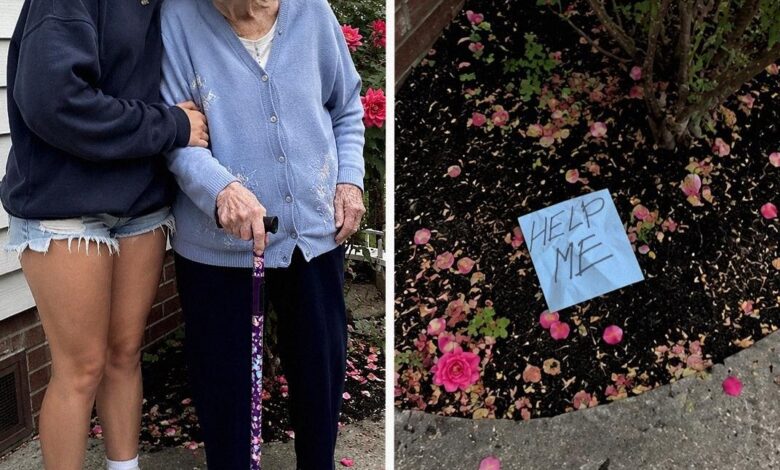
I watched the family move in across the street with a sense of quiet dread that I couldn’t quite explain. To the outside world, they were the picture of suburban perfection: Jim, the stern father; Carla, the silent mother; and Eva, their teenage daughter who seemed to carry the weight of the entire world on her fragile shoulders. But through my window, I saw the cracks. It wasn’t just the way Jim’s voice turned ice-cold when he addressed her; it was the way Eva flinched, a reflex born of constant, unrelenting fear. When I finally found her handwritten note tucked beneath my roses, I knew I was about to walk into a nightmare.
Eva began visiting my garden under the guise of helping me with chores, a flimsy excuse her father used to offload her on the neighborhood’s elderly. She wasn’t lazy; she was a girl living in a state of hyper-vigilance, constantly scanning the perimeter for threats. During our quiet Tuesday tea sessions, I tried to offer her a sanctuary, a place where she didn’t have to be perfect, measured, or corrected. I asked her how she managed the impossible pressure of her life—straight A’s, dance rehearsals, and domestic perfection—but she only gave me a hollow smile that failed to reach her eyes. The strain was becoming visible, a physical erosion of her spirit that kept me awake at night.
The breaking point arrived on a humid Tuesday. After she left, I discovered a crumpled piece of paper buried under a rose bush. The words “HELP ME! EVA” were scrawled in frantic, desperate ink. My heart stopped. I knew she had been afraid of her father, but I had underestimated the depth of her terror. Without pausing to deliberate, I grabbed my cane and hobbled across the street. The front door was slightly ajar, a silent invitation to a scene of domestic tyranny that I was entirely unprepared to witness.
I stepped into the hallway, and the sight inside made my blood run cold. Jim sat in an armchair, holding a notebook as if he were a teacher grading a failing student. He was reading aloud from a meticulous log: the exact time Eva woke up, the caloric content of her breakfast, the duration of her dance practice, her posture, and even the seconds spent brushing her teeth. It was a prison of data, a calculated attempt to strip her of her individuality and mold her into a submissive doll. Neither of them noticed me at first; Eva stood stiffly, staring ahead with a thousand-yard stare, completely disconnected from the suffocating reality of her own home.
I broke the tension with a sudden, unannounced intrusion, forcing myself into the room with a feigned casualness that required every ounce of my fading courage. I claimed I needed Eva’s help with the roses immediately, creating an exit strategy that Jim was too startled to challenge. As we reached my yard, the dam finally broke. Eva spilled the truth: her father had been keeping these invasive logs for years, turning her existence into a continuous, audited performance. Her mother, Carla, was a silent witness to the abuse, paralyzed by her own fear and refusal to intervene. Eva wasn’t just asking for help; she was gasping for air in a house that functioned like a laboratory of control.
I spent the next forty-eight hours executing a plan that required both patience and a recording device. I invited Jim to my home for tea under the pretense of seeking his “organizational advice,” a stroke of ego-bait that he couldn’t resist. While he sat in my living room, smugly explaining the virtues of his “system” and the necessity of pressure in shaping children, my phone sat quietly on the table, capturing every chilling word. He admitted to the logs, the monitoring, and the psychological warfare he waged to ensure his daughter’s absolute obedience. It was the digital proof I needed to pull the strings of authority.
I contacted Sarah, an old friend who worked in family services, and sent her the audio file. She confirmed that Jim had a history of this precise behavior, having destroyed a previous marriage with the exact same pattern of surveillance and emotional isolation. The evidence was damning, but the danger of direct intervention was high; if we moved too quickly, the situation inside the house might boil over. We decided to approach Carla instead, hoping to empower her to take the lead. I walked into their kitchen while Jim was out and confronted Carla with the recording, placing the digital weight of her husband’s cruelty directly in her hands.
Carla’s reaction was a startling departure from her usual submissiveness. She watched as I played the clip of Jim explaining his warped philosophy, and I saw the scales finally fall from her eyes. She didn’t want a long, drawn-out legal battle; she wanted a way out. She sent the recording to Jim and confronted him with the weight of the evidence, backed by the implicit threat of total exposure. Jim, faced with the prospect of his carefully curated life being stripped away by the authorities, was forced to negotiate terms of total capitulation.
Life didn’t pivot overnight, but the house across the street finally began to breathe. When Eva returned to my garden the following week, the change was palpable. The notebook was gone, the surveillance had ended, and for the first time, she was allowed to be an adolescent rather than a subject of study. Carla had forced him into therapy as a condition of their continued cohabitation, a fragile and imperfect start, but a start nonetheless. I still watch them from my window, but now, when Eva works among the roses, she laughs. It is a loud, chaotic, and completely unmeasured sound, the sound of a girl who has finally been given permission to exist.