Wyoming Territory winter of 1887 strains widowed rancher Samuel Parker and his seven children

The winter of 1887 settled heavily over the Wyoming Territory.
Snow drifted against fences. The wind moaned across the open prairie. And every evening, when the sun disappeared behind the distant hills, the Parker cabin seemed far too large for one exhausted man.
Samuel Parker stood on the porch and looked out over his ranch.
At thirty-nine years old, he was known throughout the county as one of the hardest-working cowboys around. He owned nearly six hundred acres, hundreds of cattle, and a reputation for honesty that few could match.
Yet none of that mattered much when he walked back into the cabin.
Because waiting inside were seven children.
Seven hungry, noisy, growing children.
The youngest, four-year-old Tommy, still cried for his mother at night.
The oldest, sixteen-year-old Rebecca, tried her best to help, but she was still a child herself.
Three years earlier, Samuel’s wife, Margaret, had died from pneumonia during a brutal winter storm.
Since then, life had become a daily battle.
Every morning began before sunrise.
Samuel fed livestock.
Milk had to be collected.
Wood chopped.
Water hauled.
Meals cooked.
Clothes washed.
Children educated.
Fences repaired.
Cattle managed.
There simply weren’t enough hours.
The children survived, but surviving wasn’t the same as living.
Their meals were often burnt biscuits, overcooked beans, or tough beef stew.
Their clothes were patched repeatedly.
The cabin felt quiet in the wrong ways and chaotic in all the others.
One February evening, Samuel sat at the rough wooden table while the children argued over supper.
“This bread is hard as a rock,” complained twelve-year-old Luke.
“Then don’t eat it,” Rebecca snapped.
Tommy started crying because his spoon fell.
Eight-year-old Sarah accidentally knocked over a cup.
The dog barked.
Someone stepped on a toy wagon.
Samuel rubbed his tired eyes.
The room fell silent.
His children looked at him.
For a moment, he saw something that hurt more than exhaustion.
Loneliness.
Not his.
Theirs.
They missed having someone who made a house feel like home.
That night, after everyone was asleep, Samuel pulled out a sheet of paper.
He stared at it for a long time.
Then he began writing.
A simple advertisement.
Widowed rancher seeks wife.
Must be kind, hardworking, and able to cook for a large family.
Seven children.
Honest intentions only.
Samuel Parker, Willow Creek Ranch.
He folded the paper and mailed it to the local newspaper the next morning.
The moment he did, he felt foolish.
Who would willingly marry a cowboy with seven children?
Who would choose endless chores and hard frontier life?
Apparently, several women would.
Letters began arriving within weeks.
Some wanted financial security.
Some wanted land.
Others seemed more interested in becoming owners of a ranch than members of a family.
Samuel read every letter carefully.
None felt right.
Then one arrived written in neat handwriting on inexpensive paper.
The envelope was plain.
The message was short.
Mr. Parker,
I saw your advertisement.
I can cook.
I can sew.
I can work hard.
But more importantly, I know what it feels like to be alone.
If you would like to meet, I would be honored.
Respectfully,
Clara Whitmore.
No promises.
No demands.
No mention of money.
Just honesty.
A week later, Samuel drove his wagon into town.
When he arrived at the boarding house where Clara lived, he found himself staring in surprise.
The woman waiting near the entrance was not what he expected.
She was tall and broad-shouldered.
Her blue dress stretched comfortably around a generously built figure.
She looked strong enough to lift sacks of grain.
Yet her face held a softness that immediately put people at ease.
Kind brown eyes.
A warm smile.
The sort of expression that made strangers feel welcome.
“You must be Mr. Parker,” she said.
“And you must be Clara.”
They shook hands.
Her grip was firm.
The conversation that followed lasted nearly three hours.
Samuel learned she was thirty-four years old.
Her parents had died years earlier.
She had never married.
Most of her life had been spent caring for relatives, cooking for large households, and helping neighbors whenever they needed assistance.
“What made you answer my advertisement?” Samuel finally asked.
Clara looked out the window.
“When my mother was dying, she told me something.”
“What was that?”
“She said that people spend too much time looking for perfect lives.”
Samuel waited.
Clara smiled.
“She said the better thing is finding people who need you.”
For the first time in years, Samuel felt hope.
Three months later, they married in a small church attended by neighbors and friends.
The children were uncertain.
Especially Rebecca.
She stood quietly during the ceremony.
Afterward, she watched Clara carefully.
Waiting.
Judging.
Looking for signs that this new woman might disappoint them.
The first few days were awkward.
Everyone seemed unsure of their place.
Then came the morning that changed everything.
Samuel woke to unfamiliar smells drifting through the cabin.
Fresh bread.
Cinnamon.
Bacon.
Real bacon.
Not burnt bacon.
Perfect bacon.
He followed the scent into the kitchen.
The sight nearly stopped him in his tracks.
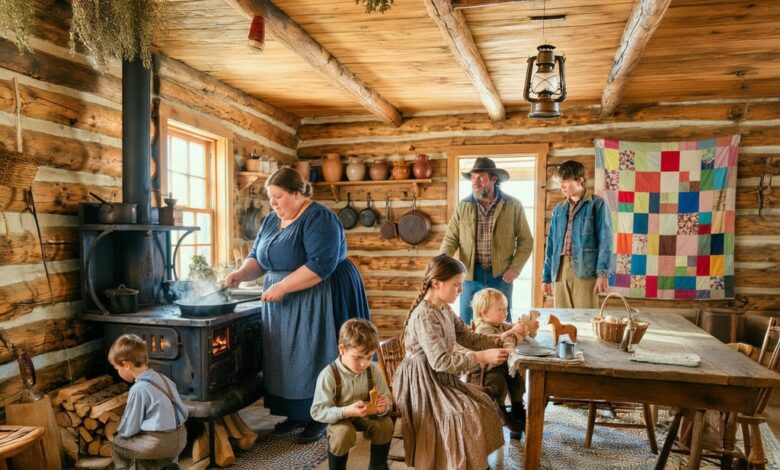
Clara stood beside the large cast-iron stove in her blue dress.
Warm firelight illuminated the room.
Bread cooled on racks.
A pot of stew simmered.
Pancakes stacked high on a platter.
The children crowded around the table.
Nobody was arguing.
Nobody was complaining.
Nobody was crying.
They were simply eating.
And smiling.
Even Rebecca.
“What happened here?” Samuel asked.
Clara laughed.
“I made breakfast.”
“This isn’t breakfast.”
She raised an eyebrow.
“No?”
“This looks like a celebration.”
The children burst into laughter.
For the first time in years, the cabin felt alive.
Not merely occupied.
Alive.
Over the following weeks, Clara transformed the household.
Not through strict rules.
Not through force.
But through care.
She taught Sarah how to bake biscuits.
She showed Luke how to mend clothing.
She read stories to Tommy before bedtime.
She organized chores so nobody felt overwhelmed.
She even convinced stubborn teenage boys that bathing regularly was not a personal attack.
The changes spread beyond the kitchen.
Soon laughter filled rooms that had once been silent.
Music returned.
Neighbors visited more often.
Sunday dinners became local events.
People started finding excuses to stop by the Parker ranch.
Some came for Clara’s famous apple pie.
Others came because the cabin somehow made them feel welcome.
One evening, Samuel returned after a long day repairing fences.
The sun had already set.
Through the cabin window, he saw a familiar scene.
Children gathered around the table.
The dog sleeping near the stove.
Firewood stacked neatly.
Dried herbs hanging from the rafters.
Clara helping Tommy sound out words from a book.
The room glowed with warmth.
For a moment, Samuel simply stood outside.
Watching.
Listening.
Feeling something he hadn’t felt since Margaret died.
Peace.
When he stepped inside, Clara looked up and smiled.
“How was your day?”
“Long.”
“Dinner’s almost ready.”
Samuel nodded.
Then he noticed something.
Tommy had fallen asleep with his head resting against Clara’s arm.
The little boy who once cried every night for his mother.
Clara gently brushed hair from his forehead.
The gesture was small.
Natural.
Unthinking.
Yet it struck Samuel harder than he expected.
Because in that moment he realized something.
He had searched for a wife who could cook.
But what had entered their lives was something far greater.
And he was only beginning to understand just how much greater it truly was.
A Cowboy With Seven Children Asked for a Wife Who Could Cook — What She Brought Into Their Lives Was Worth Far More
Part 2
Spring arrived slowly across Wyoming.
The snow melted from the hillsides. Creeks swelled with fresh water. Green grass pushed through the earth, and cattle once again spread across the open range.
Life at Willow Creek Ranch settled into a rhythm unlike anything Samuel Parker had known in years.
For the first time since Margaret’s death, the ranch felt less like a place of survival and more like a home.
Clara never tried to replace anyone.
She never asked the children to call her Mother.
She never demanded affection.
Instead, she earned trust one small act at a time.
She remembered birthdays.
She repaired torn jackets before anyone asked.
She sat beside frightened children during thunderstorms.
She celebrated accomplishments that others might overlook.
And somehow, without anyone noticing exactly when it happened, she became the center of the family.
Even Rebecca eventually lowered her guard.
One afternoon, the sixteen-year-old found Clara sitting on the porch mending clothes.
Rebecca hesitated before taking a seat beside her.
“Can I ask you something?”
“Of course,” Clara replied.
“Why did you really marry Pa?”
Clara smiled softly.
“That’s a serious question.”
“I’m serious.”
The older woman placed the sewing basket on her lap.
“When I first met your father, I saw a good man carrying too much weight.”
Rebecca listened quietly.
“And then I met all of you.”
The girl looked away.
“Most people would’ve run.”
“Perhaps.”
“But you didn’t.”
“No.”
“Why?”
Clara’s eyes drifted toward the pasture where Samuel was working.
“Because sometimes the most worthwhile things in life require the most work.”
Rebecca stared at her for a moment.
Then, unexpectedly, she leaned forward and wrapped her arms around Clara.
The embrace lasted only a few seconds.
But it was the first one.
Clara hugged her back.
Neither said a word.
Neither needed to.
By summer, neighbors openly talked about the transformation at Willow Creek Ranch.
People who visited noticed the difference immediately.
The cabin was still simple.
Still rustic.
Still crowded.
But it felt alive.
The dining table was constantly surrounded by laughter.
The kitchen was always warm.
Children who once seemed withdrawn now carried themselves with confidence.
Even Samuel looked younger.
One Sunday after church, an elderly rancher named Walter Jenkins pulled Samuel aside.
“What did that woman do to your family?”
Samuel laughed.
“What do you mean?”
Walter shook his head.
“A year ago, your children looked like they were carrying the whole world on their shoulders.”
He pointed toward the group gathered nearby.
“They look happy now.”
Samuel followed his gaze.
Tommy was chasing the dog.
Sarah and Luke were arguing playfully over a game.
Rebecca was laughing with Clara.
And for a moment, Samuel realized Walter was right.
The change was impossible to miss.
“She didn’t change the ranch,” Samuel said quietly.
“Then what did she change?”
“Us.”
Walter nodded.
As if he understood completely.
That autumn brought a challenge.
One far more serious than anyone expected.
A drought settled across the region.
Grass stopped growing.
Water levels dropped.
Several neighboring ranches struggled to keep their cattle alive.
Prices fell.
Money became tight.
Some families packed their belongings and left altogether.
Samuel worried constantly.
Every evening he sat at the kitchen table reviewing accounts.
The numbers looked worse each week.
One night, after the children were asleep, Clara joined him.
“How bad is it?”
Samuel sighed.
“Bad enough.”
She studied the papers.
“Can we make it through winter?”
“Maybe.”
“Maybe?”
He rubbed his forehead.
“If conditions don’t improve, we’ll have to sell part of the herd.”
Silence filled the room.
The fire crackled.
Outside, dry wind rattled the cabin walls.
Then Clara spoke.
“We’re not the only family struggling.”
“No.”
“What are the Jenkins family doing?”
Samuel looked surprised.
“They’re having an even harder time than we are.”
“And the Thompsons?”
“Same.”
Clara nodded thoughtfully.
The next morning she disappeared into town.
When she returned, she brought several women with her.
Within days, she had organized something nobody expected.
A community kitchen.
Families who still had extra flour shared flour.
Those with vegetables shared vegetables.
Those with meat contributed meat.
Women cooked together.
Children helped.
No family went hungry.
Neighbors who barely knew each other became partners.
People started trading labor, supplies, and support.
The entire community grew stronger.
Months later, when the drought finally ended, many local ranchers openly admitted that Clara’s efforts had saved them.
Not financially.
Emotionally.
The hardship would have been far worse if everyone had faced it alone.
Samuel watched all of it with growing admiration.
The woman who had arrived carrying a single suitcase had somehow become the heart of an entire community.
Yet she never sought praise.
Whenever someone thanked her, she simply smiled and changed the subject.
Years passed.
Children grew.
Rebecca married a schoolteacher.
Luke took responsibility for more ranch work.
Sarah became an excellent baker under Clara’s guidance.
Tommy eventually grew into a tall young man who barely remembered life before Clara arrived.
One evening, nearly ten years after their wedding, the entire family gathered at the cabin.
Grandchildren now played across the floor.
The old dog was gone, replaced by another sleepy ranch dog lying beside the stove.
The familiar cast-iron stove still warmed the room.
The rafters still held drying herbs.
The braided rug remained near the table.
The cabin looked much as it always had.
Only the family had grown.
At supper, one of the grandchildren asked a question.
“Grandpa, how did Grandma Clara come to live here?”
The room grew quiet.
Everyone smiled.
Samuel looked across the table at Clara.
Her hair now carried strands of silver.
Her face showed the marks of years spent working, laughing, and loving.
Yet to him, she was as beautiful as the day they met.
“Well,” Samuel said, leaning back in his chair, “many years ago, I placed an advertisement in a newspaper.”
The children laughed.
The grandchildren leaned closer.
“I was looking for a wife who could cook.”
More laughter followed.
“Did Grandma answer?” one little girl asked.
“She did.”
“And she could cook?”
The entire room erupted.
Because everyone knew the answer.
Clara’s cooking had become legendary.
Her pies alone were famous across three counties.
Samuel smiled.
“Yes. She could cook.”
The little girl grinned.
“Then you got what you wanted.”
Samuel looked at Clara.
For a moment, emotion caught in his throat.
Then he slowly shook his head.
“No.”
The room fell silent.
“No?”
Samuel reached across the table and took Clara’s hand.
“I got far more than what I wanted.”
The grandchildren watched curiously.
The adults understood.
Samuel looked around the room.
At his children.
His grandchildren.
The laughter.
The warmth.
The sense of belonging that filled every corner of the cabin.
“When Clara came here, I thought our biggest problem was empty stomachs.”
Several people nodded.
“But hungry stomachs weren’t the problem.”
He squeezed her hand gently.
“We were hungry for something else.”
The room grew quiet enough to hear the fire crackling.
“What was that?” a grandchild asked.
Samuel smiled.
“Hope.”
Clara blinked back tears.
“So many years ago,” he continued, “I asked for a wife who could cook. What God sent us was a woman who taught us how to be a family again.”
Nobody spoke.
Several eyes filled with tears.
Even Rebecca wiped her cheek.
Samuel stood and raised his coffee cup.
“To Clara.”
Immediately, everyone else stood.
Cups rose throughout the room.
“To Clara.”
The old cabin echoed with the toast.
Clara laughed through her tears.
“You all make me sound far more important than I am.”
“No,” Rebecca said softly.
“We don’t.”
Around the table, heads nodded in agreement.
Because every person there knew the truth.
The meals had mattered.
The fresh bread had mattered.
The warm kitchen had mattered.
But those things were never the greatest gift Clara brought.
Her real gift was making people feel seen.
Valued.
Loved.
She had taken a house full of grief and turned it into a home full of life.
And long after the food was eaten, long after the children grew up, and long after the ranch weathered its many seasons, that gift remained.
It lived in every gathering.
Every tradition.
Every act of kindness passed from one generation to the next.
The cowboy had asked for a wife who could cook.
Instead, he received the woman who became the heart of his family.
And in the end, that was worth far more than anyone could ever measure.