Golden Retriever Runs Four Miles to Save Crash Victim Trapped in Mountain Ravine

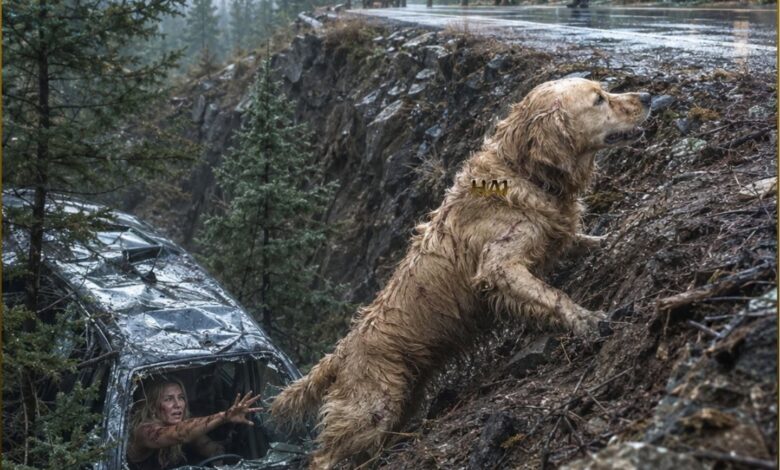
On a gloomy late autumn afternoon, my car skidded off the edge of the mountain pass, plunged into a shallow ravine, and became stuck in a clump of pines—while I sat trapped and bleeding in the wreckage where no one could see me from the road, my golden retriever, considered useless by everyone, crawled up the ravine on its torn claws, climbed the deserted highway, and ran four miles to the only house on the entire mountain and exposed the truth
At first, I thought it was the car settling. Then came a whine. Then claws scraped wet leaves outside the broken passenger window.
Mason shoved his muddy face through the empty frame.
He was alive.
His right eye was half closed beneath a bleeding cut. Pine needles clung to his fur. One front paw hovered above the ground, trembling, before he set it down again. He had been thrown through the window and landed outside the car, but somehow he was standing.
He licked my face again and again, frantic and clumsy, as though he could clean the terror off me.
I got one hand into his fur. He was wet, warm, shaking.
That warmth undid me.
“Mason,” I breathed. “Oh, baby.”
He whined and pushed his head harder against my hand. Above us, the highway was invisible. No cars passed. No voices called out. The mountain held its breath.
I tried to move my legs. The pain was so deep and immediate that I nearly passed out. I stopped trying. My mouth tasted like copper. My thoughts began to slip around the edges.
The truth settled slowly. No one had seen us go over. The car was below the road, blocked by trees and brush. My phone was unreachable. I was bleeding somewhere inside my body. Mason and I were alone.
I looked at my dog, my sweet cowardly dog who hid from the vacuum cleaner and once barked at his own reflection in a dark oven door.
“Go,” I whispered.
He stared at me.
“Go get help.”
He knew none of that. Not the way humans mean it. He knew come. He knew dinner. He knew no, which he treated as a weak suggestion. He knew the sound of my keys and the drawer where I kept treats. He did not know ravine, internal bleeding, no cell service, or four miles to the nearest house.
But I pushed my hand through the broken window and pointed uphill.
“Go, Mason. Please.”
He looked at my hand. Then he looked at the slope.
For one selfish second, I wanted to grab his collar and keep him with me. He was the only warm thing in that ruined car. He was the only soul who knew where I was. Fear made love greedy. It told me to hold on.
But survival asked me to let go.
My fingers loosened.
“Go.”
Mason backed away from the window. He took one step toward the slope and slipped immediately. His hurt paw folded under him, and he rolled into wet leaves before scrambling upright. Mud streaked his chest. He looked back at me, panting hard.
“You can do it,” I whispered, though my voice barely existed. “You can.”
He tried again.
He did not run up that ravine. He climbed it. He dug his paws into mud and roots, dragging his body upward inch by inch. Twice he slipped backward. Once he hit a rock and yelped so sharply that my whole body tried to move toward him, but the wreck held me like a trap.
Halfway up, he stopped. He turned and looked down.
I will never forget that look. People like to describe animals in human terms after they do something extraordinary. They call them noble, wise, brave. Mason did not look noble. He looked terrified. He looked hurt. He looked like a dog who wanted his person and did not understand why the world had broken open between them.
Then he lowered his head and climbed again.
When he reached the top, he stood on the edge of the road, fur dark with mud, tail low, one ear pinned back.
I pointed again.
He turned west.
And he ran.
After Mason disappeared, the wreck became larger. That sounds impossible, but it is true. His presence had made the broken car feel like a place. Without him, it became a hole.
I tried to stay awake by naming things. Steering wheel. Pine branch. Coffee. Sock. Glass. Blue blanket. Blood. I told myself not to say the last word, then said it again because it was true.
At some point, I heard an engine above and screamed until my throat tore. The sound faded. No brake lights appeared. No one stopped. Later, I would learn that two cars passed within twenty minutes of the crash. Neither driver saw even a flash of metal below the road.
Not visible from travel lane.
Those words would appear in the accident report, neat and cold.
Not visible from travel lane.
It is a clean phrase for being erased.
While I drifted in and out beneath the road, Mason was moving through a world that had no reason to help him. Blue Hollow Pass had no sidewalks, no gas station, no store, no steady traffic. The forest pressed close on both sides. The wet pavement scraped his torn pads every time his paws struck it. Cars, if they came, would have been as dangerous as rescue.
But four miles down from the curve, set back behind a gravel drive and two black walnut trees, stood the only occupied house on that stretch of mountain.
It belonged to Gideon Harlan and his wife, Ruth.
I learned their version later, first in pieces from a nurse, then from Ruth herself, who told stories the way some women quilt, joining scraps into something warm enough to survive in.
Gideon was seventy-eight, a retired highway maintenance supervisor with a back stiff from old injuries and hands permanently marked by grease, sun, and work. Ruth was seventy-four, sharp-eyed, churchgoing, and capable of making you feel loved and corrected in the same sentence. They had lived on Blue Hollow Road for forty-three years. They knew every bend, washout, fallen tree, and careless driver on that pass.
They also knew the curve where I went over.
Fifteen years earlier, their daughter, Emily, had died there after sliding off the same shoulder on an icy January morning. Her car had gone farther down than mine. No dog had climbed out. No one had seen the broken guardrail posts beneath the snow until it was too late.
Since then, Gideon had fought the county for a proper guardrail. He wrote letters. He attended meetings. He brought photos. He carried a folder thick with accident reports and drainage maps. The county patched signs, repainted lines, and promised studies that led nowhere.
A month before my crash, Gideon had told Ruth he was done begging people to care.
Then Mason reached his porch.
Ruth said she heard the first bark from the kitchen. Not a playful bark. Not the uncertain bark of a dog asking whether anyone was home. It was one hard, urgent sound, followed by claws scraping wood.
Gideon opened the door with a coffee mug in his hand.
Mason stood there soaked and bleeding.
The first thing Gideon noticed was that the dog did not try to come inside. A lost dog usually looks for warmth. A hurt dog looks for safety. Mason looked toward the road, then back at Gideon, then grabbed the cuff of his jeans and pulled.
“Easy, boy,” Gideon said.
Mason pulled harder.
Coffee spilled across the threshold.
Ruth came up behind her husband. She saw Mason’s cut eye, his torn paws, the mud on his belly. Then she saw what Gideon had not yet noticed.
There was a strip of gray fabric caught in Mason’s collar, twisted around the metal ring with a tiny smear of blood on it.
Ruth had worked thirty years as an emergency room clerk. She knew what seat-belt fabric looked like when it tore.
“Gid,” she said quietly. “That dog came from a car.”
Mason barked toward the road.
Gideon’s face changed. Ruth told me later it was like watching an old wound open behind his eyes.
He grabbed his truck keys from the hook. Ruth picked up the landline and dialed 911 because cell service on that mountain was more rumor than fact.
The dispatcher asked what the emergency was.
Ruth said, “An injured dog just came to our house, and he is trying to lead my husband somewhere. We think someone went off Blue Hollow Pass.”
The dispatcher asked whether they could see a vehicle.
“No,” Ruth said. “But the dog can.”
Mason refused to get into Gideon’s truck. Gideon tried twice. Mason backed away, shaking, then limped down the gravel drive and stood in the road looking back.
So Gideon followed him with his hazard lights flashing.
Mason ran ahead as far as his body allowed, stopped, turned, waited, and ran again. A living arrow. A bleeding prayer. Every few minutes, Gideon leaned out the window and called, “Show me, boy.”
Mason showed him.
At the curve, Mason left the asphalt.
Gideon almost missed the break in the brush even then. That was how completely the mountain had swallowed the Subaru. He parked crooked across the shoulder, set the brake, and climbed out. Mason was already scrambling down the slope.
Gideon stood at the edge and saw the roof of my car below.
He said later that the sight knocked the breath out of him because for half a second it was not my Subaru down there. It was Emily’s old sedan under January snow. It was every meeting where men in clean shirts told him the numbers did not justify the cost. It was fifteen years of arriving too late.
Then Mason barked from below, and Gideon came back to the present.
“Ma’am!” he shouted. “Can you hear me?”
I do not remember answering the first time. I remember Mason’s bark. Then a man’s voice, shaky but close enough to be real, called again.
“Ma’am, help is coming! Stay with me!”
Mason’s head appeared in the passenger window. His mouth was open. His tongue hung out. His body trembled with exhaustion.
“You came back,” I tried to say.
It may have been only air.
Gideon did not climb all the way down because the slope was too slick and the car looked unstable. But he stayed where I could hear him. He told me his name. He told me his wife had called 911. He told me not to move.
I kept asking about Mason.
Every time, Gideon answered, “He’s right here, sweetheart. He did good.”
That sentence became a rope thrown through the dark.
He’s right here.
He did good.
The fire crew arrived thirteen minutes after Gideon found me. I know that because the report says so. My memory is less precise. It gives me fragments. Red lights pulsing through trees. Boots sliding on wet leaves. A paramedic’s gloved hand reaching through broken glass to touch my neck. Someone saying, “Pulse is thready.” Someone else saying, “We need to stabilize before extraction.” A blanket. A collar around my neck. A saw. Mason barking once when a firefighter got too close to the car, then quieting when Gideon knelt beside him.
The rescue took forty-six minutes.
I survived because the pines caught the car, because Mason found the road, because Gideon understood what he was seeing, because Ruth believed a bleeding dog, because strangers trained for terrible moments climbed down a mountain and refused to let me disappear.
But survival is not a clean line. It is a chain. If one link breaks, the whole story ends differently.
At the hospital in Asheville, I woke under white lights with my throat dry, my body heavy, and a machine beeping beside me. A nurse said my name. A doctor explained words I could not hold: surgery, internal bleeding, fractured femur, cracked ribs, concussion, blood loss.
I lifted one hand because it was all I could move.
“My dog,” I whispered.
The nurse leaned closer.
“Mason.”
Her face softened. “He’s at Mountain View Animal Clinic. He’s hurt, but he’s alive.”
Alive.
The word entered me more powerfully than any medication.
The next day, a state trooper came. His name was Alvarez, and he had kind eyes that did not soften the seriousness of his job. He told me my car had gone off Blue Hollow Pass around 3:39 p.m. He told me the vehicle was not visible from the travel lane. He told me my dog had alerted a nearby resident at approximately 4:17 p.m.
Then he paused.
“There’s something else,” he said.
Pain made my thoughts slow. “What?”
“Your brake line was damaged.”
I tried to understand. “From the crash?”
“That’s what we assumed at first.” He looked toward the door, then back at me. “But the initial inspection suggests the line may have been cut before impact.”
The room seemed to shrink.
I remembered Eric crouching near the rear tire.
Helping.
I remembered the brake pedal sinking too low before the curve.
I closed my eyes.
Trooper Alvarez did not push me. He waited until I opened them again.
“Is there anyone who might have wanted to harm you, Ms. Donovan?”
I almost laughed. Not because anything was funny, but because the truth had spent so long being dismissed that hearing someone ask for it plainly felt unreal.
“My husband,” I said.
The word tasted old.
By evening, the police had spoken with my attorney. By morning, they had searched the house I had left and found the old phone Eric thought I still used, hidden in a kitchen drawer where he had placed it after disabling its location sharing. He had sent three texts from it after my crash, all to himself, written to make it look as if I had changed my mind and planned to come home. They found a recent increase in my life insurance benefit through a policy Eric managed. They found a utility knife in his truck with brake fluid residue on the blade.
He told them I was unstable.
He told them I had threatened to hurt myself.
He told them Mason must have distracted me.
Men like Eric do not run out of explanations. They run out of people willing to believe them.
Gideon Harlan was not one of those people.
When he heard what the trooper suspected, Gideon drove to the sheriff’s office with the strip of seat-belt fabric Mason had carried to his porch sealed in a plastic sandwich bag. Ruth had saved it because she saved everything that might matter. On that fabric, investigators found my blood and traces of brake fluid from the underside of the car, likely picked up when Mason climbed through the broken window and scraped against the damaged frame.
It was not enough by itself to convict anyone.
But it proved Mason had come from the crash, not from some unrelated wandering. It helped establish the timeline. It forced investigators to treat the crash scene as more than a weather accident before the car was crushed and hauled away. It preserved attention.
Attention can be evidence before evidence has a name.
Eric was arrested eleven days after the crash. Attempted murder, insurance fraud, evidence tampering. The news called it a domestic violence case because newspapers need categories. I called it what it was: the last door of a burning house finally closing behind me.
But the story the town cared about first was Mason.
The local paper ran a photo of him in a plastic cone, looking deeply offended by heroism. The headline called him “Blue Hollow’s Golden Guardian.” People mailed toys, treats, blankets, and cards. A third-grade class sent drawings of him wearing a cape, though Mason would have been terrified of a cape if anyone had tried to put one on him.
Gideon and Ruth kept him while I recovered. They visited me every other day, bringing updates as if Mason were a difficult celebrity under their management.
“He ate chicken but rejected kibble,” Ruth reported once, standing beside my hospital bed with her purse tucked under her arm. “Don’t look at me like that. He’s earned opinions.”
Gideon brought photos on his phone. Mason asleep on a braided rug. Mason with bandaged paws. Mason staring suspiciously at a ceramic rooster in Ruth’s kitchen. Mason lying beside Gideon’s work boots as if guarding the man who had followed him.
The first time Gideon visited without Ruth, he stood awkwardly near the foot of my bed, turning his cap in both hands.
“I owe you an apology,” he said.
I blinked. “For what?”
“For not getting that guardrail put in sooner.”
The guilt in his voice was so old it had roots.
“You found me,” I said.
“Mason found me.”
“You listened.”
He looked down.
I understood then that gratitude can hurt the person receiving it if they believe someone else deserved the same miracle first.
“Tell me about her,” I said.
He raised his eyes.
“Your daughter.”
For a while, he said nothing. Then he pulled the chair closer and told me about Emily. She had been twenty-nine, a school librarian in Morganton, engaged to a man who never married anyone after her. She loved peach ice cream, bluegrass festivals, and books with maps in the front. She had called Gideon the night before she died to ask whether the road would be bad. He had told her to take the interstate.
“She said the pass would save twenty minutes,” he murmured. “Twenty minutes.”
He did not cry. His face simply folded inward around the loss.
I reached for his hand. He gave it to me carefully, like he did not trust himself with kindness.
“I’m sorry,” I said.
He nodded.
A week later, from my hospital bed, I gave a statement to the county board. My attorney held the phone because my hands shook. Gideon stood in the back of the meeting room with Ruth beside him and Mason’s bloody collar in a clear evidence bag on the table. The room was full for once. Reporters had come for the dog. They stayed for the history.
Ruth read the names of seven crashes on that curve in fifteen years.
Gideon read Emily’s.
Trooper Alvarez explained the visibility problem. A fire captain explained the extraction. My doctor, who had no patience for political language, explained that ten more minutes could have killed me.
Then Ruth said, “The county has spent fifteen years deciding whether that curve was worth the money. Yesterday, a dog decided faster than all of you.”
The guardrail was approved before Thanksgiving.
That was not the only thing Mason changed.
When I was discharged, Gideon arrived in his old red Ford with Mason in the back seat. Ruth had argued that Mason should stay calm. Mason had argued with his entire body that calm was not available.
I was rolled out of the hospital in borrowed sweatpants, a coat that did not close right over my bandages, and a brace on my leg. The automatic doors opened. Cold air touched my face. Mason saw me.
The sound he made was not a bark or a whine. It was something broken and joyful that seemed to come from the center of him.
He tried to leap from the truck, forgot his paws were still healing, and would have tumbled straight onto the pavement if Gideon had not caught him around the chest.
“Hold on, hero,” Gideon grunted.
Mason wriggled free enough to reach me. He pressed his head into my lap so hard the wheelchair rolled backward. I put both hands in his fur and felt every breath move through him.
“You came back,” I whispered.
Of course he had.
That was Mason’s whole philosophy of love. Leave if you must, but come back with help. Come back with your whole heart. Come back even if your feet are bleeding.
Recovery was not beautiful. People like to wrap survival in inspirational language, but the body is practical and often cruel. It hurts when it heals. It humiliates you before it strengthens you. For months, I needed help showering, standing, sleeping, walking from the bed to the kitchen. My new duplex outside Marion had three steps to the porch, and those three steps might as well have been a mountain.
Ruth came on Tuesdays with soup and gossip. Gideon came whenever something “needed fixing,” which apparently included a loose porch rail, a squeaky cabinet, a suspicious gutter, and once, my entire mailbox post, which had been perfectly fine until he decided it leaned with bad character.
Mason slept by the front door for weeks. Every passing truck made him lift his head. At night, when pain or fear woke me, he pressed his chin against my knee and stayed until my breathing changed.
Eric’s trial happened the following spring.
By then, I could walk with a cane. I wore a navy dress Ruth helped me choose because she said black gave Eric too much satisfaction. Mason could not come into the courtroom, but Gideon carried his collar in his coat pocket with my permission.
Eric looked smaller at the defense table than he had in my kitchen. That surprised me. Fear had enlarged him in my memory until he seemed everywhere. In court, he was just a man in a pressed shirt trying to look misunderstood.
His lawyer argued weather. Stress. An unfortunate road. A frightened dog. A grieving wife exaggerating a bad marriage after a tragic accident.
Then the prosecutor played the 911 call.
Ruth’s voice filled the courtroom.
“There is an injured dog here, and he is trying to take my husband somewhere. We think someone is hurt.”
The dispatcher asked if she could see a person.
“No,” Ruth said. “But the dog can.”
I heard people shift in the benches behind me.
Next came the mechanic, the brake expert, Trooper Alvarez, my attorney, the insurance records, the texts Eric sent from my old phone, the knife from his truck, the fluid traces, the timeline Mason created by reaching Gideon’s porch before Eric could claim I had disappeared voluntarily.
Evidence does not always roar. Sometimes it arrives limping, covered in mud, refusing to step inside because someone still needs help.
When the guilty verdict came, I did not feel victorious. I felt tired. I felt sad for the woman I had been, the one who thought leaving quietly would be enough. I felt grateful in a way so large it had no clean place to land.
Outside the courthouse, a reporter asked me what I wanted people to learn from Mason.
I looked toward the parking lot, where Ruth was feeding him bits of turkey from a napkin despite having promised not to spoil him.
“I want people to stop calling gentle things useless,” I said.
That line made the newspaper. Ruth clipped it and taped it to her refrigerator.
Two years later, the guardrail on Blue Hollow Pass was finished. Not a temporary barrier. Not another sign. A real steel rail curving along the shoulder where the mountain dropped away. The county held no ceremony, which was probably wise, because Ruth would have brought fifteen years of notes and ruined everyone’s morning.
But we held our own.
On a bright October afternoon, Gideon, Ruth, Mason, and I drove to the curve. I was the one driving. My hands shook at first, but Mason sat in the back seat wearing a harness, because I had become the sort of person with very strong opinions about dogs in cars.
We parked safely beyond the bend. Gideon carried a small bouquet of wildflowers for Emily’s cross. I carried a tennis ball for Mason because he seemed to believe every serious human moment could benefit from recreational equipment.
The new rail shone silver in the sun.
Gideon stood beside it for a long time. Ruth slipped her hand into his.
“I wish it had been here,” he said.
“I know,” she answered.
No one insulted the truth by saying everything happened for a reason. Some things happen because people fail. Some miracles arrive because a dog refuses to accept that failure as final.
Mason sniffed the grass near the shoulder, then pressed against my leg. He did not understand guardrails, county budgets, attempted murder, grief, or justice. He understood that we were together. Maybe that was the wiser understanding.
Gideon looked at me then.
“You know,” he said, “when he came to the door, I thought for one second Emily had sent him.”
Ruth squeezed his hand.
I looked at Mason, who was trying to eat a stick with the seriousness of a scholar.
“Maybe she did,” I said.
Gideon smiled through tears. “Maybe she knew I’d listen to a dog before I listened to another politician.”
Life after that did not become perfect. It became mine.
I kept the duplex. I planted lavender beside the porch because Ruth said it would attract bees and make the place look less like “a rental with trust issues.” I took a job at a small veterinary clinic near Marion, first at the front desk, then assisting with intake. Animals in distress did not frighten me the way people expected. I understood them. Pain has a language before it has words.
Gideon and Ruth became family in the slow, unofficial way people sometimes do when they meet at the edge of disaster and decide to keep showing up afterward. We spent Thanksgivings together. Gideon taught me how to change my own brake pads, though he inspected my work with offensive skepticism. Ruth taught me how to make biscuits and then announced I had “potential,” which from Ruth was nearly applause.
Mason aged into a softer, grayer version of himself. His muzzle whitened. His hips stiffened. He still feared the vacuum cleaner, which proved heroism has limits. He still loved delivery drivers, children, dropped popcorn, and anyone willing to scratch the spot behind his left ear.
People kept calling him brave.
I never corrected them, but I always thought the word was incomplete.
Bravery sounds clean. Mason’s courage was muddy. It was confused. It trembled. It did not understand the whole danger. It only understood that love had pointed uphill and asked him to go.
That is what I tell people now when they ask how I survived.
The pines caught the car. The firefighters cut me out. The surgeons stopped the bleeding. Trooper Alvarez followed the evidence. Ruth believed what she could not yet prove. Gideon opened the door.
But Mason found the door.
My gentle, ridiculous, useless dog ran four miles on torn paws and carried the truth in his collar before anyone knew there was truth to carry.
I used to think courage meant knowing what you were doing.
Now I know better.
Sometimes courage is a frightened dog climbing a wet ravine because the person he loves pointed toward a road. Sometimes it is an old man answering a bark with old grief in his chest and choosing not to look away. Sometimes it is a woman leaving a house where danger knows her name, even if she has to learn afterward that leaving is not a single act but a life rebuilt step by painful step.
And sometimes, when the world has hidden you below the road where no one can see, love does not stay beside you.
It runs.
It runs until it finds help.
Then it turns around and brings that help home.
THE END