

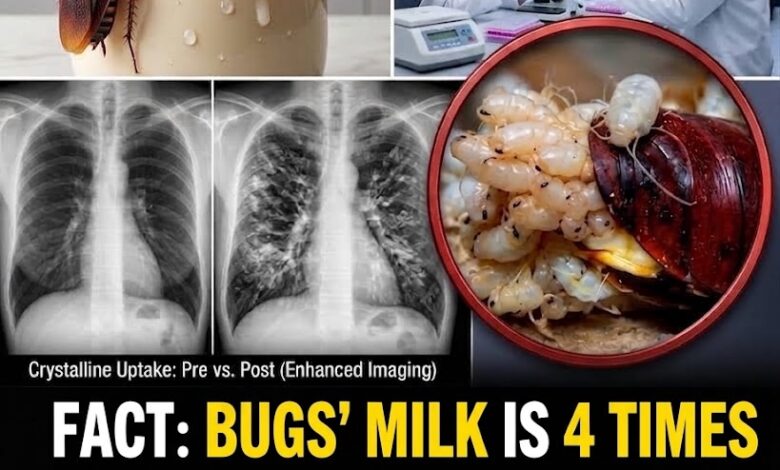
Cockroach milk sounds like something from a science-fiction movie, but the idea comes from a real and fascinating biological discovery.
Unlike most cockroach species, one particular species gives birth to live young rather than simply laying eggs.
Inside the mother, developing embryos receive nourishment from a special substance produced in her body.
As the embryos consume it, the fluid forms tiny, nutrient-rich crystals inside them.
Scientists often refer to these crystals as “cockroach milk” because they provide nourishment to the developing young in a way that is somewhat comparable to how milk supports newborn mammals.
What makes the substance especially interesting is its remarkable nutritional concentration.
Researchers have found that the crystals contain proteins, fats, sugars, and essential amino acids that help support growth.
Some studies have suggested that, by weight, the substance can contain considerably more energy than ordinary dairy milk.
It also contains all nine essential amino acids—the amino acids humans need to obtain through their diet because our bodies cannot produce them in sufficient amounts.
That unusual nutritional profile has led scientists to investigate whether the substance could have future applications in food or nutrition research.
But that doesn’t mean cockroach milk is about to appear on supermarket shelves.
There is a major problem: collecting the substance directly from cockroaches would be extremely inefficient and impractical.
Instead, researchers have explored ways of studying or reproducing its nutritional components using laboratory techniques.
And then there is the biggest challenge of all—consumer acceptance.
For many people, the thought of eating something associated with cockroaches is enough to make them lose their appetite immediately.
So despite its impressive nutritional properties, cockroach milk remains a subject of scientific research rather than a mainstream food.
It is a fascinating example of how nature can produce unexpected solutions to biological problems.
Something that sounds completely bizarre at first may actually teach scientists valuable lessons about nutrition, reproduction, and future food technologies.




