
My 13 Year Old Son Took a Dishwashing Job Without Telling Me Then His Boss Called and Asked……………….

The Secret Behind His Paychecks
For six long months, thirteen-year-old Evan told his mother that he was saving every paycheck to buy the mountain bike he had always dreamed of.
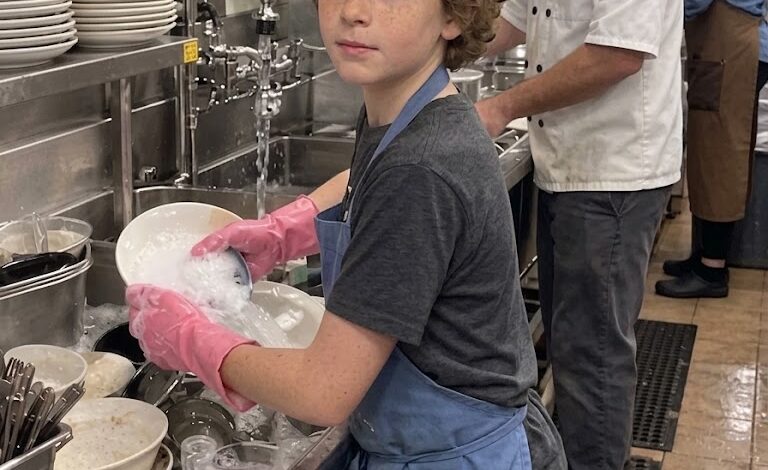
Every Saturday, he went to work at a small neighborhood diner, washing dishes and helping wherever he could. Whenever his mother asked about the bike, he would smile and say, “I’m getting closer, Mom. Just a little more time.”
But the bike never came.
Slowly, Evan began acting differently. He stopped talking about his savings, hid his paychecks, and became unusually quiet whenever his mother asked him how much money he had earned.
Something was wrong, but she couldn’t figure out what.
Then, one afternoon, the diner’s owner called her.
“Ma’am, I think you need to know what your son has been doing with his money,” he said carefully. “The things he’s told you about saving for that bike… they’re not the whole truth.”
Her heart sank.
“What do you mean?” she asked.
The owner paused before answering. “Your son has been giving his paychecks away.”
Evan’s mother rushed to the diner, her mind filled with questions. Had someone threatened him? Was somebody taking advantage of him? Why would a thirteen-year-old give away everything he earned?
When she arrived, she found Evan standing near the back entrance, holding a paycheck in his hand. He was arguing with Cal, one of the diner workers.
“Please, Cal. Just take it,” Evan insisted.
Cal shook his head. “No, Evan. I already told you. You don’t owe me anything.”
“But I do!” Evan replied, his voice trembling. “My dad said people should pay back what they owe.”
His mother stepped closer.
“Evan, what’s going on?”
He immediately lowered his eyes.
The diner owner took a deep breath and explained what he had discovered. In six months of working, Evan had kept only one paycheck for himself. The rest had gone to different people and businesses around town.
His mother could hardly believe it.
“Where did all that money go?” she whispered.
Evan didn’t answer.
That evening, while searching for an explanation, she found something hidden beneath a stack of clothes in his room.
It was a bus map.
The paper was covered in circles, handwritten addresses, and small dollar amounts. Some locations were marked with names. Others had notes beside them.
A tire shop.
A barber.
A grocery store.
And several places connected to people who had helped their family after Jeremy, Evan’s father, passed away.
Her hands began to shake.
The next morning, she visited the tire shop marked on the map.
The owner recognized Evan immediately.
“That boy came here a few weeks ago,” he said. “He brought me an envelope with $180 inside.”
“Why?” Evan’s mother asked.
The man looked surprised. “He said your husband had once needed a tire and couldn’t pay for it at the time. Evan told me he was there to settle the debt.”
She stared at the envelope on the counter.
“He was only a little boy back then,” she said quietly.
“I know,” the owner replied. “I tried to explain that the money wasn’t necessary. But he wouldn’t listen.”
The owner pushed the envelope toward her.
“I never accepted it.”
Evan had been carrying a debt that was never his to pay.
When his mother finally confronted him, he broke down.
“Dad always said we have to remember the people who help us,” Evan whispered. “He said if someone stands beside you when you’re struggling, you don’t forget them.”
His mother pulled him close.
“Your father believed in helping people,” she said. “But he also knew how to accept help.”
Evan wiped his tears.
“But Dad can’t do it anymore,” he said. “So I thought I had to do it for him.”
His mother felt her heart break.
Evan wasn’t simply saving money. He was trying to carry on his father’s unfinished responsibilities, believing that every person who had helped their family was a debt he had to repay.
He remembered Mrs. Donnelly, who had driven him to school when his mother couldn’t manage the transportation. He remembered the grocery store that had allowed their family to pay later. He remembered the barber who had given his father a free haircut during a difficult time.
To Evan, none of those acts of kindness had been forgotten.
But somewhere along the way, gratitude had turned into a burden.
“Evan,” his mother said gently, “your father didn’t leave you a list of debts to pay. He left you a heart that knows how to care about people.”
Evan looked at her, confused.
“You don’t have to become your father,” she continued. “And you don’t have to spend your childhood taking care of everyone around you.”
His lips began to tremble.
“I thought you needed me to help,” he admitted. “I thought if I didn’t do it, nobody would.”
His mother hugged him tightly.
“I need you to be my son,” she whispered. “Not another caretaker. Not someone who thinks he has to fix everything. Just my son.”
Evan finally let himself cry.
For the first time in months, he didn’t try to be strong.
He didn’t try to solve a problem.
He simply allowed his mother to hold him.
A few days later, Evan returned to the diner. He still worked hard, but this time, he kept his paycheck.
His mother helped him create a savings plan. They talked about the difference between kindness and responsibility, between remembering someone’s help and feeling forced to repay every good deed.
Evan still wanted the mountain bike.
And now, he was allowed to want something for himself.
Several months later, Evan finally had enough money.
He bought the mountain bike he had dreamed about for so long.
His mother watched as he rode it through the park, his face bright with happiness. The wind moved through his hair, and for the first time in a long while, he looked like an ordinary thirteen-year-old boy.
Then he noticed a younger child sitting beside a fallen bicycle.
The child’s chain had come off, and he was struggling to fix it.
Evan stopped.
“Do you need some help?” he asked.
Together, they worked on the chain until the bicycle was working again.
The child’s father offered Evan some money.
Evan smiled and shook his head.
“No, it’s okay. Just help someone else when they’re stuck.”
Then he climbed back onto his bike and rode away.
His mother stood nearby, timing him as he raced down the path.
This time, Evan wasn’t trying to repay an old debt.
He wasn’t carrying someone else’s responsibilities.
He was simply choosing to be kind.
And that was the greatest gift his father had ever left him.




