

Why Your Fingers Wrinkle in Water Is More Fascinating Than You Think
Have you ever noticed how your fingers become wrinkled after spending a few minutes in the bath, swimming pool, or even while washing dishes? It may seem like a completely ordinary reaction, but there is much more happening beneath the surface than most people realize. For years, people assumed that fingers simply absorbed water and became swollen. However, scientific research has revealed that this familiar change involves the nervous system and may even help explain how the human body adapts to wet environments.
The Mystery Behind Wrinkled Fingers
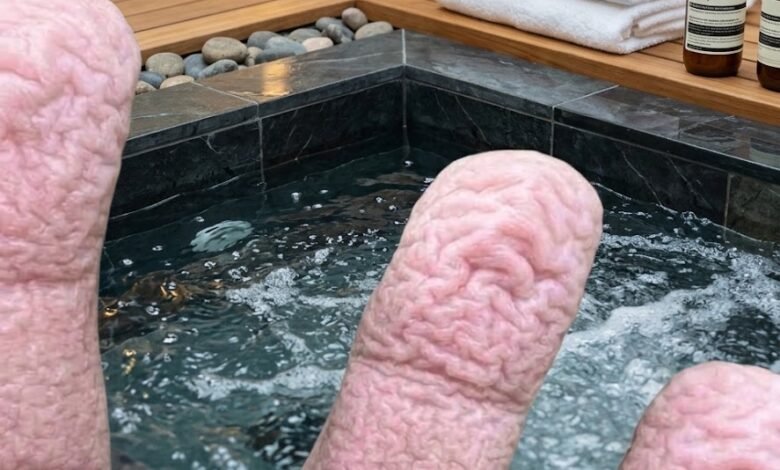
Almost everyone has experienced wrinkled fingertips after spending enough time in water. The skin gradually develops noticeable ridges and grooves, especially around the fingertips and toes. The effect is temporary, usually disappearing after the skin dries.
For a long time, the common explanation was that water entered the outer layers of the skin, causing them to expand unevenly. Although the outer skin interacts with water, this explanation alone does not account for the full process. Researchers discovered that the wrinkling response depends on functioning nerves, making it more complicated than simple water absorption.
This discovery changed the way scientists understood the phenomenon. Rather than being merely a passive reaction, water-induced finger wrinkling involves changes in the blood vessels beneath the skin. The body appears to be actively controlling a response that has intrigued researchers for decades.
What Actually Happens Beneath Your Skin?
When your fingers remain submerged in water, the skin begins to develop wrinkles, often becoming noticeable after several minutes. The exact timing varies from person to person and depends on the conditions.
The outermost layer of skin, called the stratum corneum, consists mainly of dead skin cells held together by protective lipids. This layer helps protect the body and limit water loss. When the fingers remain in water, changes occur within the outer skin, but the familiar wrinkles are not explained by this process alone.
Researchers studying people with certain nerve injuries found that affected fingers sometimes failed to wrinkle normally when immersed in water. This provided important evidence that the nervous system plays a central role.
The autonomic nervous system, which controls many involuntary bodily functions, helps regulate blood vessels. During water-induced wrinkling, blood vessels beneath the skin constrict, a process known as vasoconstriction. As the volume of tissue beneath the skin changes, the surface forms the ridges and grooves we recognize as wrinkled fingertips.
In other words, your fingers are not simply soaking up water like a sponge. Their appearance changes through a coordinated biological response involving the skin, nerves, and underlying blood vessels.
Could Wrinkled Fingers Actually Help You Grip Things?
One of the most interesting questions scientists have explored is whether wrinkled fingers serve a useful purpose. Why would the human body develop such a specific response to being in water?
A leading theory suggests that wrinkles may improve grip in wet conditions. Researchers at Newcastle University investigated this possibility by asking participants to handle objects under different conditions. Their findings suggested that people with wrinkled fingers could transfer certain wet objects more effectively than people whose fingers were not wrinkled.
The proposed explanation is surprisingly similar to the design of tire treads. Grooves in a tire help channel water away from the contact surface, improving contact with the road. In a similar way, the grooves on wrinkled fingertips may help water move away from areas where the skin touches an object.
If this interpretation is correct, the response could have offered an advantage when handling wet stones, plants, or other objects in damp environments. Better control over slippery objects would have been useful in many everyday situations.
However, scientists continue to investigate exactly how the wrinkles affect grip in different circumstances. The potential evolutionary advantage is an influential explanation, but it should not be treated as a complete answer to every question about the phenomenon.
Why Do Some Fingers Wrinkle Faster Than Others?
The time it takes for fingers to wrinkle is not identical for everyone. Many people notice the effect after approximately five to ten minutes, although the timing can vary depending on water temperature, the duration of immersion, and individual differences.
Warm water may make the change noticeable sooner for some people, while colder conditions can alter the response. Skin characteristics and individual physiology may also influence how pronounced the wrinkles become.
The amount of time spent in water matters as well. A quick hand rinse usually does not produce the same effect as a long bath or an extended swimming session. As immersion continues, the ridges may become more visible before gradually fading after the fingers are removed from the water.
Soap and other substances can affect the skin’s surface, but their presence does not by itself explain the entire wrinkling process. The response involves several interacting factors rather than one simple cause.
Can Wrinkled Fingers Reveal Something About Your Health?
For most people, wrinkled fingers are completely normal and harmless. The skin generally returns to its usual appearance after drying, and the wrinkles do not mean that the fingers have been damaged.
However, researchers have also studied water-induced wrinkling as a possible indicator of nerve function. Because the response depends partly on the autonomic nervous system, an unusual lack of wrinkling may sometimes provide a clue that further medical assessment is worth considering.
Certain nerve conditions can affect the normal response. For example, autonomic nerve damage associated with some medical conditions may interfere with the processes that contribute to finger wrinkling. Researchers have investigated water-immersion testing as one way of examining these responses.
Still, the absence of wrinkles does not automatically mean someone has nerve damage. Results can vary, and a single observation is not enough to diagnose a medical condition. Anyone concerned about persistent changes in sensation, movement, circulation, or other symptoms should speak with a qualified healthcare professional rather than relying on a home water test.
Why Don’t All Parts of the Body Wrinkle the Same Way?
Another interesting detail is that the fingers and toes often develop especially noticeable wrinkles, while other parts of the body do not show the same distinctive pattern under ordinary conditions.
Hands and feet regularly interact with objects and surfaces, so researchers have considered whether water-induced wrinkling may be related to the demands of gripping and handling things in wet environments. The pattern of wrinkles and the nervous system’s involvement have made the phenomenon particularly interesting to scientists studying human adaptation.
Yet the precise reasons for the differences between body regions remain a subject of scientific interest. Human skin varies in thickness, structure, and sensitivity across different areas, and these differences may influence how it responds to prolonged immersion.
The phenomenon also reminds us that the body is full of specialized responses that are easy to overlook because they happen during everyday activities.
What Scientists Still Want to Understand
Although researchers have learned a great deal about water-induced finger wrinkling, some questions remain. Scientists continue to investigate the biological signals involved, the exact relationship between wrinkles and grip, and how the response varies among individuals.
The research may also have practical applications beyond understanding human biology. Engineers interested in biomimicry—the practice of taking inspiration from nature—have explored whether features of biological surfaces could inform the design of materials and devices that need to handle wet objects.
Such ideas could eventually contribute to improved gripping surfaces, tools, or prosthetic technologies. These possibilities remain areas of exploration rather than established benefits of finger-wrinkling research.
An Everyday Mystery With a Scientific Explanation
Finger wrinkling is a reminder that some of the most fascinating scientific questions begin with ordinary experiences. What seems like a small change in appearance actually involves the skin, blood vessels, and nervous system working together.
The idea that wrinkles may help us handle wet objects adds another intriguing layer to the story. Although scientists are still exploring the full explanation, the research shows that our bodies can respond to environmental conditions in ways that are more sophisticated than they first appear.
So the next time your fingertips become wrinkled after a bath or a swim, remember that it is more than a sign of time spent in water. It is a temporary biological response that offers a glimpse into the remarkable ways the human body functions—and how much there is still to learn about even the simplest things we experience every day.




