

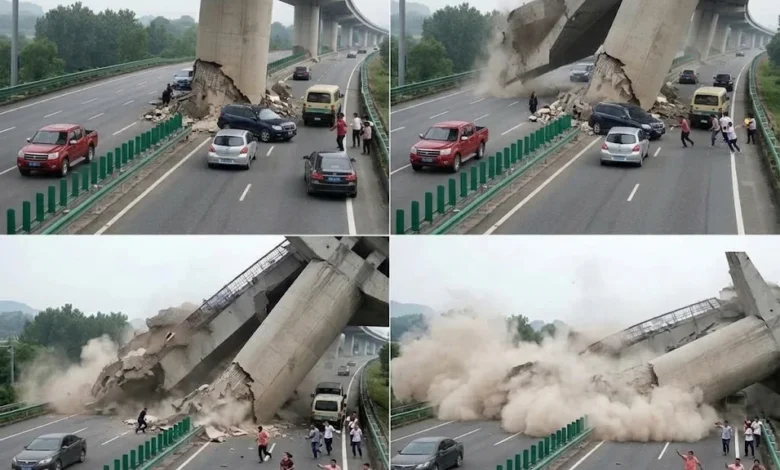
A Breaking News Headline Has Everyone Curious—But What Actually Happened?
A quiet road. A sudden announcement. Then a dramatic headline suggesting that an unexpected event has just taken place. Within minutes, a story like this can begin circulating online, attracting attention from readers who want to know what happened.
But sometimes, the headline raises more questions than it answers.
The image accompanying this particular headline shows a small section of roadway alongside the words, “BREAKING NEWS: Just Minutes Ago, An Unexpected Development Has Captured Everyone’s Attention.” However, the picture does not identify a location, show a recognizable vehicle, name anyone involved, or explain what supposedly occurred.
Those missing details are important. A dramatic headline does not prove that an accident happened, that a road was closed, or that anyone was injured. Even a photograph cannot establish those claims without additional evidence.
So what can readers actually learn from a headline like this? The best approach is to look at the available information, understand how breaking news develops, and recognize the difference between verified facts and speculation.
Curiosity is natural when something unexpected appears in the news. But taking a moment to examine the evidence can prevent confusion and help readers understand what is genuinely known.
1. A Headline That Creates Suspense Without Explaining the Event
The expression “just five minutes ago” immediately makes a story sound urgent. It suggests that something important has happened moments before the reader encountered the post.
Adding the phrase “unexpected development” makes the headline even more mysterious. Readers may begin wondering whether it involves a traffic accident, an emergency, a public announcement, or another event affecting the community.
Yet the available screenshot does not identify any of these possibilities.
It contains a small road photograph and a general headline, but no confirmed location, date, people involved, or explanation of the supposed development. The accompanying text mainly discusses how breaking news attracts attention and why early reports sometimes contain incomplete information.
That distinction should not be overlooked.
It would be irresponsible to describe the image as evidence of a collision, damaged road, or emergency response when none of those things can be established from what is shown.
A more useful question is not simply, “What happened?” but rather, “What information do we actually have?”
Starting with that question makes it easier to separate the headline’s dramatic presentation from the facts that have been provided.
2. Why the Words “Just Five Minutes Ago” Attract Attention
Few headline expressions create urgency as quickly as “just five minutes ago.”
The wording makes readers feel that they are receiving exceptionally recent information. It can also create the impression that they are among the first people to discover an important development.
That sense of urgency often encourages people to open an article immediately, share it with friends, or return later hoping to find additional information.
Fast reporting can certainly be valuable. During an emergency, timely updates may help people avoid dangerous locations, understand traffic restrictions, or follow instructions from local authorities.
However, the wording becomes problematic when the urgency is much greater than the information available.
A genuine breaking-news report should ideally include a clear publication time, identify the location, and explain what has actually been confirmed.
For example, a traffic announcement should identify the affected road and explain whether motorists need to expect delays. A public announcement should name the organization or individual responsible. A report about a serious incident should distinguish between confirmed information and early witness accounts.
The screenshot provides none of these details.
Its headline creates excitement, but the photograph and visible text do not explain the event.
This is why readers should look beyond the opening sentence. A dramatic phrase is not proof, and a photograph of a road does not establish that an emergency took place.
The most important question remains: what new information does the article provide?
If readers cannot find a clear answer, they should avoid treating the headline as confirmation of a particular event.
3. What the Road Photograph Actually Reveals
The photograph accompanying the headline is quite small. It appears to show part of a roadway, some lane markings, and a barrier or raised edge along one side.
There is no clearly recognizable vehicle, emergency crew, damaged structure, crowd, or identifiable landmark.
Even if the photograph is authentic, its meaning remains uncertain.
Road photographs appear in many different types of articles. They may accompany reports about traffic conditions, construction work, transportation announcements, road safety, or accidents.
The same kind of image could be used to illustrate a highway closure or a general discussion about traffic management.
Without additional information, there is no reliable way to determine which subject the photograph is intended to represent.
Several important details are missing:
- Location: The image does not identify a road, town, city, or country.
- Time: There is no information establishing when the photograph was taken.
- Direction: The route and direction of traffic are not clearly identified.
- Event: No specific incident is visibly taking place.
- People involved: No individual or vehicle can be connected to a particular event.
- Official confirmation: There is no visible statement from police, transport officials, or emergency services.
These missing details matter because photographs are frequently shared without their original context.
An older image may be reused alongside a newer headline. A photograph taken in one country might appear in an article about another. An ordinary roadway image could also be selected simply because it fits the general subject of a post.
That does not automatically make the photograph fake. It simply means that the image cannot prove more than what it actually shows.
A reliable article should explain where its photographs came from and whether they depict the real location or are being used for illustration.
Until that information is available, the safest conclusion is straightforward: the picture shows a roadway, but it does not establish what happened there.
4. How an Early News Report Becomes a Verified Story
Most developing stories begin with an initial piece of information.
It might come from someone who witnessed an event, an emergency call, an official announcement, a local authority, or a journalist who notices something unusual.
At the beginning, however, important details may still be missing.
A driver might notice traffic suddenly stopping without knowing the reason. Someone nearby might see emergency vehicles but have no information about whether anyone was injured. Another person might hear a loud sound without seeing what caused it.
Journalists must investigate before presenting an explanation as fact.
The first step is establishing the basic details: what happened, where it happened, and when it occurred.
These questions are essential. Without a location, reporters may struggle to contact the correct authorities. Without a reliable time, an older event could be confused with a current one. Without an accurate description, separate incidents might mistakenly be treated as the same story.
The next step is checking information with reliable sources.
Depending on the subject, journalists may contact police departments, fire services, ambulance services, transportation authorities, government offices, or the organization connected to an announcement.
Witnesses can also provide useful information, although their accounts must be examined carefully. People may see only part of an event, misunderstand what happened, or remember details differently when they are under pressure.
Photographs and videos can help establish what took place, but these materials also require verification. A genuine video may have an inaccurate caption. A photograph might show a real incident but come from another location. A short recording may leave out important events that happened before or afterward.
Once the available information has been checked, journalists can prepare a report that separates confirmed details from unanswered questions.
This process takes time.
A short article containing a few verified facts can be much more valuable than a lengthy report filled with unsupported claims.
The visible text in the screenshot makes a similar point: early information may be incomplete while journalists contact witnesses and examine official statements.
That is a reasonable explanation of how developing news should be handled. As evidence becomes available, the story should become clearer—not simply more dramatic.
5. How Social Media Makes Unclear Stories Spread
The way people receive breaking news has changed considerably.
Many readers now encounter headlines through social media feeds before seeing a detailed report from an established news organization.
This can be useful. People can share emergency warnings, communicate with relatives, and draw attention to local problems such as severe weather or blocked roads.
But the same speed can also spread inaccurate information.
One person may share a headline without reading the article. Another may copy it and add a more dramatic description. Someone else might repost the photograph with a claim that was never included in the original report.
Before long, several different versions of the same story may be circulating.
Readers can then find it difficult to determine which details are accurate.
This problem becomes more noticeable when posts use broad expressions such as “unexpected development,” “everyone is talking about it,” or “more details are coming.”
Such wording encourages curiosity without explaining the central event.
The screenshot includes sharing options for Facebook, Twitter, and Pinterest. These are common features of online publishing, but they also demonstrate how quickly a headline can move from one platform to another.
As a post gets shared, it may become separated from the original article. Someone who sees a repost might never read the full explanation or notice that important details are missing.
Repeated sharing can also create a misleading impression of confirmation.
If several accounts repeat the same unverified claim, that does not mean several independent sources have confirmed it. They may all be repeating information from one original post.
Readers can help prevent this confusion by checking the original publisher, looking for independent confirmation, and avoiding unsupported additions when sharing information.
The purpose should not be to discourage people from sharing important news. It should be to make sure that the information being circulated is accurate and useful.
6. Understanding the Difference Between Traffic Problems and Emergencies
Because the screenshot contains a road photograph, readers might naturally wonder whether the headline concerns a traffic incident.
That is one possible subject for a road-related report, but the image does not establish that such an event occurred.
Still, it is worth understanding why developments involving roads can attract public attention.
Roads connect homes, workplaces, schools, hospitals, and businesses. A disruption on an important route can affect many people, even when the original problem is relatively small.
Traffic problems can occur for numerous reasons, including:
- Road repairs or construction.
- A broken-down vehicle.
- Temporary traffic restrictions.
- Severe weather.
- Special public events.
- Vehicle collisions.
- Problems involving nearby infrastructure.
Some disruptions are planned, while others happen unexpectedly.
A serious emergency is a different situation. It may involve injured people, hazardous materials, dangerous obstructions, or damage that creates a risk to the public.
The distinction matters because a traffic delay does not automatically mean that a major emergency has occurred.
A responsible report should explain the actual situation rather than making every disruption sound equally serious.
If a road is closed for maintenance, the article should say so. If emergency services are responding to an accident, the report should explain what has been confirmed. If officials are still investigating the cause, that uncertainty should be made clear.
Early information can also change. A road might be temporarily closed while authorities inspect a possible hazard. The inspection could later establish that no major incident occurred. In another situation, an initially minor obstruction might require a larger response.
The evidence should determine the description, not the excitement of the headline.
7. What Authorities May Do When a Road Emergency Is Reported
When officials receive a report of a possible road emergency, their first concern is usually determining the immediate danger and deciding what response is necessary.
The appropriate response depends on the information available.
A report of a vehicle blocking a lane may require a different response from a collision involving injuries or a hazardous substance.
When responders arrive, they may need to establish whether anyone requires medical assistance, whether traffic must be stopped, and whether the surrounding area presents an ongoing danger.
Keeping additional vehicles away from a hazardous location can be particularly important. Drivers approaching an incident at normal speed may create further risks for people already at the scene.
Authorities may use cones, signs, barriers, or emergency vehicles to guide traffic away from the affected area.
Emergency personnel also need enough space to work. Ambulances, fire engines, and rescue vehicles must be able to reach the scene without unnecessary interference from traffic or spectators.
After the immediate danger has been addressed, officials may begin examining what happened.
Depending on the circumstances, this could involve inspecting vehicles, road surfaces, traffic signals, barriers, or nearby infrastructure.
Witnesses may be interviewed, available camera recordings may be reviewed, and different accounts may be compared to establish a clearer timeline.
Public updates can be released during this process, especially when a road closure affects a large area.
However, authorities may withhold details that have not been confirmed or that could interfere with an investigation.
Waiting for accurate information can be frustrating, particularly when speculation is already spreading online. But unverified claims can create unnecessary alarm, send drivers towards unsafe routes, or unfairly blame individuals.
A brief but accurate update is often more useful than a detailed explanation based on assumptions.
8. Why Identifying the Location Is So Important
One of the most valuable details in any breaking-news report is the exact location.
When an event involves a road, identifying the area helps motorists understand whether their journeys may be affected. It also allows emergency services and residents to understand where the situation is developing.
A useful traffic report should ideally identify the road, the affected section, the direction of travel, and any available alternative routes.
It should also explain whether the restriction affects one lane, several lanes, or the entire road.
Nearby landmarks can make the information easier to understand. A junction, bridge, tunnel, or highway exit may help readers identify the affected area.
The screenshot provides none of these details. It does not name a city, country, or specific road.
As a result, readers cannot determine whether the headline refers to a local development or something with a wider impact.
A report may initially be published before the location has been confirmed. If so, the publisher should clearly explain that limitation and update the article when reliable information becomes available.
Readers should be cautious about posts claiming that a road is closed without identifying which road is involved.
They should also avoid assuming that a photograph shows a familiar location simply because the road markings look similar.
A vague warning may attract attention, but a specific and verified location is what allows people to make informed decisions.
9. Signs That an Online Article May Still Be Incomplete
An article that lacks information is not automatically misleading.
During the early stages of a major event, journalists may have only a small number of confirmed details. A brief report can still be responsible if it clearly explains what is known and what remains uncertain.
However, some online posts create the appearance of breaking news without providing meaningful information.
Readers can look for several warning signs.
First, check whether the event is actually identified. If the headline promises an unexpected development but the article never explains what happened, readers still do not have a complete story.
Second, look for a date and location. A report claiming that something happened moments ago should provide a publication time and enough information to establish where the event took place.
Third, examine the sources. Reliable reporting may refer to an official announcement, identify a spokesperson, or explain that certain details remain unconfirmed. Vague references to what people are supposedly saying are not enough on their own.
Fourth, examine the photographs. Does the article explain where the image came from? Does it actually show the event, or is it simply an illustration? A mismatch between the photograph and the caption deserves attention.
Fifth, read the entire article. Sometimes a dramatic headline is followed by general paragraphs that could describe almost any situation. If the article repeatedly promises further details without identifying the event, it may not offer a meaningful news update.
The screenshot’s visible text mainly discusses the general challenges of reporting breaking news. It explains why early information can be incomplete and why readers may encounter conflicting versions online.
Those observations are useful, but they do not confirm a particular incident.
Recognizing this limitation is simply a matter of reading the available material carefully.
10. Why Photographs and Their Captions Must Be Examined Together
A photograph can be authentic while the caption attached to it gives the wrong impression.
This is a common challenge in online reporting because images are sometimes shared far beyond their original context.
A picture from an older incident may be reused alongside a recent headline. An ordinary road photograph might be placed beneath a story about an emergency. An image taken in one country could circulate with a description referring to another.
In each case, readers may believe the photograph proves something that it does not.
A careful examination should begin with visible details.
Are there road signs, recognizable buildings, vehicle markings, or landmarks? Do those details match the location identified in the article? Is there any information establishing when the photograph was taken?
Reverse image searches can sometimes reveal earlier appearances of a picture. They may show that an image was published in an older report or originally belonged to another event.
However, those results also need to be checked. A photograph appearing on several websites does not automatically mean that any of them identifies its original source.
The caption should be evaluated separately.
If it claims that a specific incident took place, the article should provide evidence for that statement. If the image is simply being used to illustrate a general topic, it should not be described as proof of an accident.
This becomes particularly important when photographs involve emergency scenes or injured people. Misleading captions can distress families, spread false claims, and create confusion among people who may be connected to the event.
A photograph can show what was visible at the moment it was taken. It cannot automatically establish everything that happened before or afterward.
11. Why Accurate Public Safety Updates Matter
Although the screenshot does not identify a specific emergency, breaking news can play an important role in protecting the public.
Accurate traffic information may help motorists avoid dangerous areas. Weather warnings can prevent unnecessary journeys. Clear evacuation instructions can help residents understand what actions they need to take.
But for an update to be genuinely useful, it must provide specific information.
A good public safety announcement should explain what is happening, where it is happening, which authority is providing the information, and whether people need to take action.
If something remains uncertain, that should be stated clearly.
For instance, saying that a road has been officially closed is different from saying that authorities are investigating a possible obstruction. One describes an established restriction, while the other describes an ongoing assessment.
Readers need to understand that difference.
When immediate safety is involved, official sources are particularly important. Police departments, fire services, transportation authorities, and local government agencies may provide information about road closures, emergency responses, and public instructions.
Established news organizations can also help explain those announcements and provide additional context.
Sharing unverified warnings can have real consequences. An incorrect road-closure claim may send drivers on unnecessary detours. A false emergency report can create panic. Unsupported claims about injuries or deaths can cause serious distress to families.
Accurate information is therefore more than a matter of good reporting. It can influence decisions that affect people’s safety.
12. What to Do When a Breaking-News Headline Provides Few Answers
When a headline promises urgent news but the article does not explain what happened, readers should avoid filling in the missing details themselves.
Instead, there are several practical steps they can take.
Look for the original publisher. Check whether the article identifies a reporter, publication time, or official source. If the headline appears on social media, try to locate the original post rather than relying on a screenshot or repost.
Search for independent confirmation. If a serious incident has occurred, other reliable news organizations or relevant authorities may also report it. Make sure those reports are independent rather than copies of the same unverified claim.
Separate established facts from unanswered questions. It may be accurate to say that a headline has attracted attention. It would not be accurate to claim that a major accident occurred if the available information does not establish one.
Be careful before sharing. Reposting an unclear headline may spread confusion, even if the intention is simply to keep others informed. Sometimes waiting for a reliable update is the better choice.
Check again when new information appears. A developing report may become more complete over time. If the publisher later provides a confirmed location, official statement, or clearer explanation, readers can reassess the story.
Being cautious does not mean dismissing every breaking-news report. It means allowing evidence to guide conclusions rather than letting curiosity turn an unknown detail into an assumed fact.
13. How an Unexpected Road Development Can Affect a Community
Even an event involving one small section of roadway can have consequences beyond the immediate location.
Road networks are connected, and a disruption in one place may affect nearby streets, businesses, public transportation, and people travelling to work or school.
Imagine a busy road connecting residential neighborhoods with a city center. If an unexpected obstruction occurs, drivers may be redirected onto smaller streets.
Those alternative routes may not be designed to handle the additional traffic, creating congestion in areas that were not directly involved in the original problem.
Public transport may also be affected. Buses could need to change their routes, delivery vehicles might arrive late, and emergency services may have to adjust their journeys.
The impact can be especially noticeable when an event occurs near a bridge, tunnel, major junction, or highway entrance. These locations often have fewer practical alternatives, meaning a temporary closure can affect a much larger area.
This helps explain why road-related developments often attract public interest.
People are not always concerned only about the incident itself. They also want to know whether it could affect their families, daily routines, or travel plans.
However, a useful report must explain the actual scale of the disruption.
A headline claiming that an unexpected development has captured everyone’s attention does not establish whether the event is local, regional, or national. It also does not tell readers whether traffic has been affected or whether any action is necessary.
A meaningful update should identify affected routes, explain whether alternative roads are available, and mention any official instructions.
The same approach applies to other unexpected developments. A local announcement may matter greatly to one group without affecting the wider population. Good reporting explains who is affected and how, rather than relying on dramatic wording.
14. The Importance of Witness Accounts—and Their Limitations
People who witness an event can provide valuable information during the early stages of a developing story.
They may describe what they saw, when they noticed something unusual, and how the situation appeared to unfold.
These observations can help journalists understand an incident before official information becomes available.
However, witnesses can only reliably describe what they personally experienced.
Someone who sees traffic suddenly stopping may not know the reason. A person who hears a loud noise may not know what caused it. Someone arriving after an incident may see the aftermath without knowing what happened beforehand.
This does not make eyewitness accounts useless. It simply means they need to be understood within their proper limits.
A reliable report should distinguish between direct observation and personal interpretation.
For example, a witness may accurately describe seeing emergency vehicles arrive. That observation is different from claiming to know the seriousness of someone’s injuries without reliable information.
The witness’s position also matters. Someone standing at one end of a road may not have seen what happened around a corner. A driver may have a clear view of the vehicles ahead but know very little about the wider situation.
Timing can introduce further uncertainty. People who are frightened or surprised may remember the main event clearly but struggle to recall the exact order of smaller details.
For these reasons, journalists often compare witness statements with official information, photographs, recordings, and other independent evidence.
Readers should use the same care when encountering eyewitness claims online. A personal account may contribute useful details, but it should not automatically be treated as a complete explanation.
15. The Risks of Making Assumptions Before the Facts Are Clear
A vague headline often encourages readers to imagine what might have happened.
Some may assume that the road photograph shows a serious collision. Others might speculate about a damaged bridge, an overturned vehicle, or an emergency closure.
But none of these interpretations is established by the screenshot.
Guesswork becomes particularly harmful when it involves real people.
An unsupported post might identify someone as being involved in an incident, accuse a driver of causing it, or claim that people have been injured. Such statements can spread quickly and remain online even after corrections are published.
Incorrect information can also frighten families. Someone who sees a dramatic headline may worry that a relative has been involved in an accident. False reports about injuries or deaths can create unnecessary emotional distress.
There is also the danger of blaming individuals before an investigation has taken place.
For example, a photograph of a damaged vehicle does not necessarily establish who was responsible for an incident. Determining what happened may require witness accounts, physical evidence, and an official investigation.
The safest response is to avoid completing an unfinished story with assumptions.
If the location has not been confirmed, it should remain unknown. If the cause is still being investigated, it should not be presented as a proven explanation.
As evidence becomes available, a developing story should become more informative. It should never become more sensational simply because people are speculating.
16. What Readers Should Expect From a Genuine News Update
People who return to a breaking-news article are usually looking for new information.
They want to know whether the situation has changed, whether authorities have confirmed anything, and whether there is an action they should take.
A meaningful update should provide additional facts rather than simply repeating the original headline.
For a road-related story, useful information might include:
- Confirmation of the exact location.
- An explanation of what has disrupted traffic.
- Details of any official restrictions.
- Information about alternative routes.
- Updates about when the road may reopen, if known.
- Confirmed information about the response from relevant authorities.
If people have been affected, any details about injuries or casualties should come from reliable and authorized sources. Such information should never be guessed from photographs or social media comments.
A responsible update should also explain what remains uncertain.
For example, authorities might confirm that a road is closed while continuing to investigate the reason. That is still useful information because it tells readers what has been established without pretending that every question has been answered.
The time of the update should be clearly displayed, particularly when conditions are changing quickly.
If the original headline was inaccurate or incomplete, the publisher should correct it rather than leaving a misleading title in place.
Transparency allows readers to follow the development of a story and understand how the available information has changed.
17. The Responsibility of Publishers When Writing Dramatic Headlines
Online publishers compete for attention in an environment where readers encounter countless articles and posts every day.
A headline needs to be interesting, but it also needs to accurately represent the information in the article.
There is nothing wrong with using engaging language. Problems arise when mystery and suspense replace meaningful reporting.
If an article discusses a road closure, the headline should not suggest a major disaster without evidence. If an organization has made an announcement, the title should identify the subject whenever possible. If a report is still developing, the headline should communicate that fact while remaining clear about what is known.
The wording “An Unexpected Development Has Captured Everyone’s Attention” creates curiosity but does not identify the event.
Likewise, saying that something happened “just five minutes ago” creates urgency, but without a clear timestamp or explanation, readers have little information with which to assess the claim.
Publishers should also make sure that their photographs genuinely match the subject.
If an image is used for illustration, the caption should explain that. If it depicts the actual location, the article should provide enough context to establish the connection.
This distinction is particularly important in stories involving emergencies and public safety. Readers may interpret a road photograph as evidence of an incident even when the image is merely decorative.
Accuracy and engaging writing do not have to conflict.
A headline can attract attention while still identifying the subject, location, and known circumstances. A clear report about an unexpected road disruption, for example, can explain that officials are investigating while making it clear that the cause has not yet been confirmed.
Trust develops when the headline, photograph, and article all communicate the same information.
18. The Main Lesson: A Dramatic Headline Is Not Proof
The screenshot uses several familiar techniques to attract attention. It announces breaking news, suggests that something important has happened recently, and includes a photograph of a roadway.
The words “See more” encourage readers to continue looking for an explanation.
But the visible information does not identify a specific event. It does not confirm a collision, a road closure, or any injuries. It provides no location and contains no official statement.
What it does illustrate is how an online headline can create urgency before readers have enough information to understand the subject.
That is why it is important to ask a few basic questions:
What actually happened? Where did it take place? When did it occur? Who has confirmed the information? Is the photograph connected to the event? Which details remain uncertain?
These questions help turn curiosity into informed understanding.
If the headline refers to a genuine development, further reporting should eventually explain the circumstances. If it is simply a general promotional headline without an identifiable event, readers should recognize that limitation instead of assuming that a serious incident has occurred.
Breaking news deserves attention, especially when public safety could be involved. But attention should always be accompanied by careful judgment.
Taking a few moments to check a source may prevent an inaccurate claim from spreading much further.
19. Why Waiting for Verified Information Is Worth It
The appeal of breaking news is understandable. People want to know what is happening around them, particularly when a headline suggests that an important event has just occurred.
But the desire to receive information quickly should not come at the expense of accuracy.
A developing story may begin with unanswered questions. Journalists and authorities need time to establish the location, examine the available evidence, speak with relevant people, and confirm the details.
During that period, readers should be careful not to confuse possibilities with facts.
The road photograph in the supplied material may attract attention, but it does not tell us whether an accident occurred, whether traffic was interrupted, or whether emergency personnel were involved.
Until reliable information establishes those details, the event itself remains unexplained.
That is the most important point to remember: a headline can introduce a story, but it cannot replace the evidence needed to understand it.
Curiosity is natural, but confirmation matters more. Before believing or sharing a dramatic breaking-news claim, take a moment to check what is actually known.




