My husband and I booked a room during our vacation. In the hotel room, I discovered this. I’ve been looking at it for half an hour now, but I still can’t figure out what it is. Does anyone know?…………

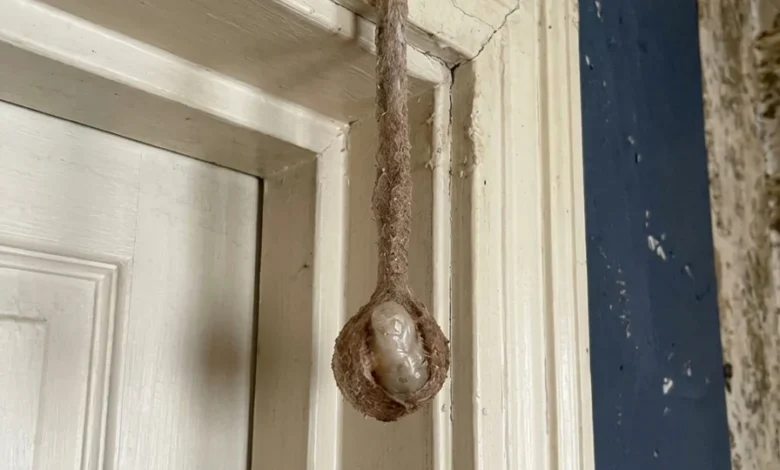
Hotel Guests Spot an Unusual Mark on Their Wall—A Closer Look Reveals a Surprising Discovery
What was supposed to be a relaxing hotel getaway quickly became an experience the couple would never forget. After a long and stressful period, they had planned a peaceful escape where they could unwind, enjoy some quiet time, and leave their everyday worries behind.
When they arrived, everything seemed perfectly normal. The hotel room looked clean and welcoming, the bed was neatly prepared, and the furniture appeared to be in excellent condition. Nothing suggested that their stay would involve an unexpected encounter with wildlife.
But shortly after settling in, something on the wall caught their attention.
At first, the unusual mark seemed like a small patch of dirt, damaged paint, or perhaps a spot that housekeeping had missed. It was easy to overlook, but something about its shape made them curious. Rather than ignoring it, they decided to take a closer look.
What they discovered was far more interesting than a simple stain.
The strange structure appeared to be a mud dauber wasp nest, built from carefully shaped layers of hardened soil.
The discovery immediately raised questions. How had an insect managed to construct a nest inside a hotel room? How long had it been there? And should the guests be worried about having a wasp nest so close to where they were staying?
What exactly is a mud dauber?
Mud daubers are solitary wasps recognized for their unusual nesting habits. Unlike many familiar wasps that live together in large colonies, these insects generally build individual nests and raise their young without depending on a large social group.
Their nests are made using small amounts of wet soil or mud. A female wasp collects the material, carries it to a suitable location, and shapes it into protective chambers. As the mud dries, it becomes hard and forms a structure that can remain attached to walls and other surfaces.
Depending on the species, a nest may look like a collection of narrow tubes, rounded compartments, or a rough cluster of mud-covered sections.
These structures are commonly found beneath roof edges, inside garages, in sheds, and around sheltered outdoor spaces. However, protected indoor areas can sometimes provide suitable nesting locations as well.
A quiet, undisturbed corner can offer exactly the kind of shelter these insects need to build their nests.
How does a mud dauber construct its nest?
The building process is surprisingly detailed for such a small insect.
A female mud dauber begins by searching for damp soil that can be shaped and transported. She gathers small portions and carries them back to the chosen nesting site, adding one section after another until a chamber begins to take shape.
Once a compartment is ready, she searches for prey, often spiders. She captures and paralyzes them before placing them inside the chamber as food for her developing offspring.
She then lays an egg and seals the compartment with mud.
When the larva eventually hatches, it has a ready supply of food waiting inside. It feeds and develops within the protected chamber before emerging as an adult wasp.
This entire process highlights how insects use surprisingly sophisticated natural behaviors to protect their young.
Should guests be worried about a mud dauber nest?
Discovering a wasp nest in a place where people sleep can understandably make anyone uncomfortable.
Fortunately, mud daubers are generally less aggressive than social wasps that defend large colonies. They usually spend their time building nests and searching for food rather than attacking people.
However, that does not mean they are completely harmless. A mud dauber can still sting if threatened, trapped, or handled. Anyone with a known insect-sting allergy should be especially cautious.
The safest response is to avoid touching the nest, disturbing the insect, or attempting to remove it without proper knowledge and equipment.
If guests discover a suspected wasp nest inside their room, they should notify hotel management and request professional assistance.
How the hotel responded
After noticing the unusual structure, the couple decided to inform the hotel staff rather than deal with it themselves.
The employees were made aware of the situation and arranged for the nest to be inspected and safely removed. This allowed the guests to avoid unnecessary contact with the insects and reduced the possibility of disturbing an active nest.
Once the issue was addressed, the room could be checked and prepared for continued use.
Although the discovery was certainly unexpected, it did not have to ruin the couple’s getaway. In fact, it became an unusual story they would remember long after leaving the hotel.
Why do insects sometimes enter human spaces?
Buildings may appear completely separate from nature, but insects and other wildlife often find opportunities to live alongside people.
Small openings, sheltered corners, unused storage spaces, and protected areas around windows or roofs can provide attractive nesting locations. Even places that are cleaned regularly may occasionally become accessible to insects looking for shelter.
Mud daubers are only one example. Spiders may settle in undisturbed corners, birds sometimes build nests beneath roof edges, and other insects may find their way into garages, sheds, and enclosed spaces.
This does not automatically mean a building is poorly maintained. Sometimes, wildlife simply takes advantage of a quiet area that offers suitable conditions.
A small discovery that became a lasting memory
For the couple, the unusual mark initially seemed like an insignificant detail that someone had forgotten to clean. But a closer look revealed a fascinating example of insect behavior.
What appeared to be dried dirt was actually a carefully constructed structure, built one small piece of mud at a time.
Their peaceful hotel visit had unexpectedly turned into an opportunity to learn about a creature most people rarely notice.
The experience also offered a useful reminder: unfamiliar nests and insects should always be approached with caution, even when they appear harmless.
Sometimes, the most surprising discoveries are hiding in the smallest and most ordinary-looking places.