
The Mystery of the Old Metal Weights: Forgotten Tools That Carry Stories From the Past

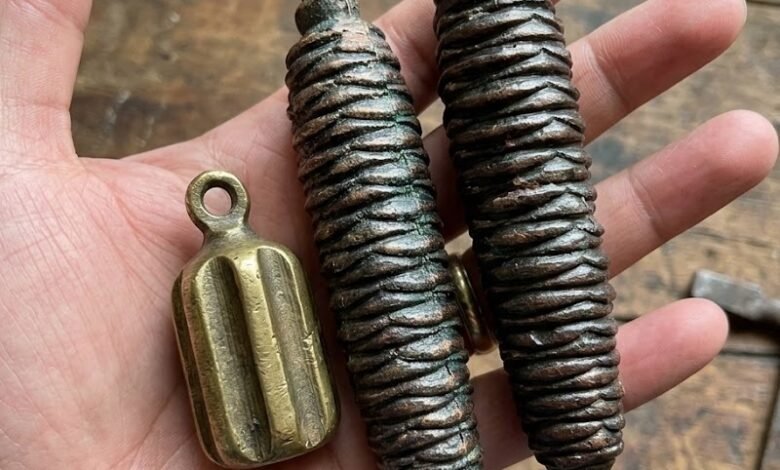
In the palm of a hand lie three small pieces of metal, each marked by time, age, and years of wear. Two are long, dark, and wrapped in thick, spiral-like ridges, while the third is made of golden-colored brass with a smooth, grooved design. At first glance, they may look like ordinary pieces of old metal, but their unusual shapes invite a deeper question: What were these mysterious objects used for?
Perhaps they once belonged to an old workshop, a traditional clock, or a machine that worked quietly for generations. The two heavier-looking pieces, with their tightly wound ridges and small loops at the top, could be components of an older mechanical device. Their weathered surfaces reveal signs of age, with darkened metal, patches of oxidation, and rough textures that suggest they have spent many years in use or storage.
The smaller brass-colored piece tells a different story. Its carefully shaped grooves and rounded opening give it the appearance of a purpose-made component rather than a random scrap of metal. It might have served as a weight, a fitting, or part of a mechanism designed to perform a specific task. Without knowing where these objects came from, however, their exact purpose remains a mystery.
What makes old objects like these fascinating is that they often outlive the people who used them. A tool that once played an essential role in someone’s daily work can eventually be forgotten in a drawer, workshop, or dusty toolbox. Years later, someone discovers it again and begins wondering about the hands that held it, the machines it operated, and the work it helped accomplish.
The photograph captures more than a few aged metal pieces. It offers a small glimpse into the world of traditional craftsmanship, where objects were often made to be durable, repaired when necessary, and used for many years. Their worn surfaces are reminders that even the simplest tools can carry traces of a much larger history.
But what exactly are these unusual metal objects? Their distinctive shapes may hold the answer. If you recognize them, or have seen something similar in an old clock, machine, or workshop, share your thoughts. Sometimes, the most interesting discoveries begin with a simple question about an object that everyone else has overlooked.




