

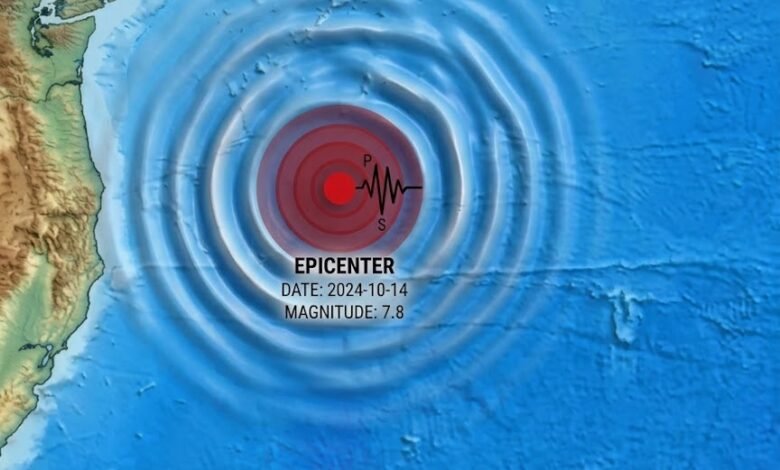
Powerful Earthquake Beneath the Atlantic? Scientists Explain the Risks and What Coastal Communities Should Know
A powerful earthquake beneath the Atlantic Ocean can raise serious concerns for coastal communities, particularly when seismic activity occurs near major underwater geological boundaries. Although earthquakes are a natural part of Earth’s constantly changing structure, a strong offshore tremor can prompt questions about possible damage, aftershocks, and the risk of a tsunami.
The Atlantic Ocean floor contains vast geological formations and fault systems where tectonic forces continue to reshape the planet. When built-up pressure is suddenly released, seismic waves travel through the Earth’s crust, sometimes reaching locations hundreds or even thousands of miles away. The strength of the shaking experienced on land depends on several factors, including the earthquake’s magnitude, depth, and distance from populated areas.
Why Earthquakes Occur Beneath the Atlantic Ocean
One of the Atlantic region’s most significant geological features is the Mid-Atlantic Ridge, an underwater mountain system formed as tectonic plates gradually move apart. As these plates shift, fracture, and interact, earthquakes can occur along sections of the ridge and other active geological structures.
Most earthquakes begin when rocks along a fault suddenly slip after accumulating stress over time. This movement releases energy in the form of seismic waves that spread through the surrounding rock.
Some underwater earthquakes are relatively small and pass unnoticed by people on land. Others can be powerful enough to produce noticeable shaking across distant coastal areas. Their effects depend on the characteristics of the earthquake and the geology of the affected region.
Could an Underwater Earthquake Trigger a Tsunami?
One of the biggest concerns after a major offshore earthquake is whether it could generate a tsunami. However, not every underwater earthquake produces a tsunami, and the location of an earthquake alone does not establish that dangerous waves are forming.
Tsunami risk is particularly significant when a strong earthquake causes substantial vertical displacement of the seafloor, pushing or pulling a large volume of water. Other factors, including the earthquake’s depth and the shape of the affected seabed, can influence the resulting waves.
Scientists assess potential tsunami threats using seismic monitoring networks, ocean-bottom instruments, deep-ocean pressure sensors, and coastal tide gauges. These systems help specialists evaluate an earthquake and determine whether unusual ocean waves have developed.
Until monitoring agencies issue an assessment, claims that an earthquake has generated a tsunami should be treated cautiously.
Aftershocks and Other Potential Dangers
Following a significant earthquake, smaller tremors known as aftershocks may occur as the surrounding crust adjusts to changes in stress. Some may be too weak to notice, while others can be strong enough to cause additional damage in areas already affected by the initial event.
For an offshore earthquake, potential hazards depend on the event’s magnitude, depth, distance from land, and local conditions. Authorities may also examine whether the earthquake has affected underwater slopes or other structures that could contribute to additional hazards.
These possibilities are reasons for careful monitoring, not proof that a particular earthquake will lead to further emergencies.
What Coastal Residents Should Do
Preparation can help people respond more effectively when an earthquake or tsunami warning occurs.
Residents in coastal areas should know their local evacuation routes, identify nearby high ground or designated evacuation buildings, and keep essential supplies readily available. It is also important to understand the emergency guidance issued by local authorities.
If you are near the coast and experience strong or prolonged earthquake shaking, do not wait for an official tsunami warning before moving to a safer location when local guidance identifies the shaking as a natural warning sign. A sudden unusual retreat of the sea or a loud ocean roar can also indicate a possible tsunami.
Move inland or to higher ground, follow designated evacuation routes, and remain in a safe location until authorities announce that the danger has passed. Do not return to the shoreline to watch the waves.
For the latest information, rely on official earthquake monitoring services, tsunami warning centers, and local emergency authorities rather than unverified social media posts.
Can Scientists Predict the Next Major Earthquake?
Despite substantial advances in earthquake science, researchers cannot reliably predict the exact time, location, and magnitude of an individual earthquake in advance.
Modern monitoring technology can detect seismic activity, estimate an earthquake’s magnitude and location, and help officials assess potential hazards. In some regions, earthquake early-warning systems can provide a brief alert after an earthquake begins but before strong shaking reaches certain locations. These alerts are not long-term predictions.
Scientists continue studying fault systems, plate movements, and the behavior of seismic waves to improve hazard assessments and emergency planning.
What We Know—and What Still Needs Confirmation
The possibility of a powerful earthquake beneath the Atlantic deserves serious scientific attention, but a specific event’s magnitude, location, tsunami risk, and consequences must be established through reliable seismic measurements and official assessments.
Without confirmed information identifying a particular earthquake, it would be misleading to suggest that a major tremor has just occurred or that coastal communities are currently facing a tsunami threat.
The broader lesson remains important: Earth’s geological systems are powerful and cannot yet be predicted with complete precision. Understanding earthquake hazards, preparing in advance, and following verified emergency instructions can help protect lives when significant seismic activity occurs.
Stay informed, remain prepared, and rely on verified scientific information rather than alarming headlines or unconfirmed warnings.




