
This Remote Alaska Town Is Slowly Being Swallowed by the Ocean—and Its Official Deadline Has Already Passed……….

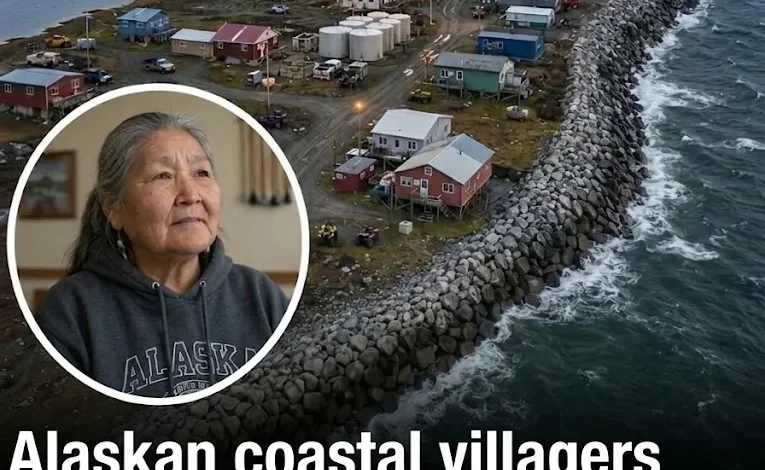
Kivalina: The Alaskan Village Fighting to Hold On as the Ocean Threatens Its Future
For generations, the people of Kivalina, a small coastal community in northwestern Alaska, have lived in close connection with the Arctic environment. The village is more than a collection of homes surrounded by water. It is a place shaped by family traditions, cultural identity, shared history, and a way of life passed down through generations.
But the landscape that once helped protect the community is changing. Rising temperatures, diminishing sea ice, and increasingly powerful coastal storms have placed Kivalina in a difficult position, forcing residents to confront a question that becomes more urgent with every passing year: how long can they continue living on land that the ocean is steadily wearing away?
A natural barrier that is disappearing
Historically, thick winter sea ice played an important role in protecting Kivalina’s shoreline. During colder months, the ice helped shield the coast from powerful Arctic waves and reduced the impact of storms.
As temperatures have increased, however, the sea ice has become less reliable. Thinner ice and shorter periods of seasonal protection leave the shoreline more exposed to strong winds and waves. When storms arrive, the consequences can be devastating.
One particularly damaging storm in 2004 reportedly swallowed more than 12 meters of coastline in a single event. For a community already facing limited space and an exposed location, losing that much land was a serious warning about the risks ahead.
The problem is not simply that the shoreline changes from year to year. Homes, roads, community facilities, and essential infrastructure all depend on land remaining stable. As erosion continues, residents face growing uncertainty about the safety of the places where they have built their lives.
The difficult question of relocation
For years, relocation has been discussed as a possible long-term solution. But moving an entire community is far more complicated than finding a safer piece of land and building new houses.
Residents have deep connections to their existing homes, ancestral territory, hunting areas, and familiar surroundings. Moving could disrupt traditional activities, separate people from important cultural places, and change the social relationships that hold the community together.
The financial challenge is equally enormous. A successful relocation would require suitable land, housing, roads, utilities, public buildings, and access to essential services. It would also require careful planning to ensure that residents could continue their livelihoods and maintain their community connections.
The account describes Janet as accepting that relocation may eventually become unavoidable, while her brother Reppi is determined to remain. His concerns reflect a problem that can easily be overlooked in discussions about climate adaptation: a location may appear safer from coastal erosion but still be difficult to live in.
One proposed area of higher ground near the local school is reportedly marshy and plagued by mosquitoes. For someone considering leaving a familiar home, these everyday conditions matter. Safety is not only about avoiding the ocean; it is also about having a place where families can comfortably build a future.
Building protection while searching for answers
While the long-term relocation question remains unresolved, efforts have been made to protect Kivalina and improve its emergency access.
One major measure has been the construction of a substantial rock seawall along vulnerable sections of the coastline. The barrier is intended to reduce wave damage and help slow erosion during storms.
Another important development was the completion of a road and bridge connection to the mainland in 2020. This infrastructure provides a route for emergency evacuation and improves access between the island community and surrounding areas.
These projects represent important investments in public safety. They can help residents respond to dangerous conditions and provide some additional protection against coastal hazards.
However, infrastructure improvements cannot completely remove the underlying risks. A seawall may reduce the force of waves reaching a vulnerable shoreline, but it does not stop climate change or guarantee that the land will remain safe indefinitely. Similarly, an evacuation route can improve emergency preparedness without solving the larger problem of where the community will live in the future.
More than a question of geography
For Kivalina’s residents, the debate is not simply about choosing between a dangerous coastline and a safer location inland. It is about balancing physical safety with cultural continuity, economic realities, and personal freedom.
Some residents may see relocation as the most responsible way to protect future generations. Others may feel that leaving means giving up a place that holds generations of memories and traditions. Both perspectives reflect understandable concerns.
The challenge is finding a solution that does not treat the community merely as a group of people who need to be moved. Residents must have a meaningful role in decisions about their future, including where they relocate, how new infrastructure is designed, and how their cultural practices and community relationships can be preserved.
A future shaped by difficult choices
Kivalina’s situation illustrates the human consequences of a changing Arctic. The loss of protective sea ice, increasingly damaging storms, and coastal erosion are not abstract environmental issues for people living there. They affect homes, transportation, public safety, and the future of an entire community.
The seawall and mainland connection offer valuable protection, but they are only part of a much larger response. The question of relocation remains emotionally and financially complicated, with no easy answer that satisfies every resident.
For Janet, Reppi, and their neighbors, the decision involves more than finding higher ground. It means deciding how to protect the people they love without losing the history and identity that make Kivalina home.
As the coastline continues to face pressure from the changing Arctic, the community’s struggle serves as a powerful reminder that climate change is not only transforming landscapes. It is also forcing people to reconsider where they can safely live, what they may have to leave behind, and how much of their heritage they can carry into an uncertain future.




