

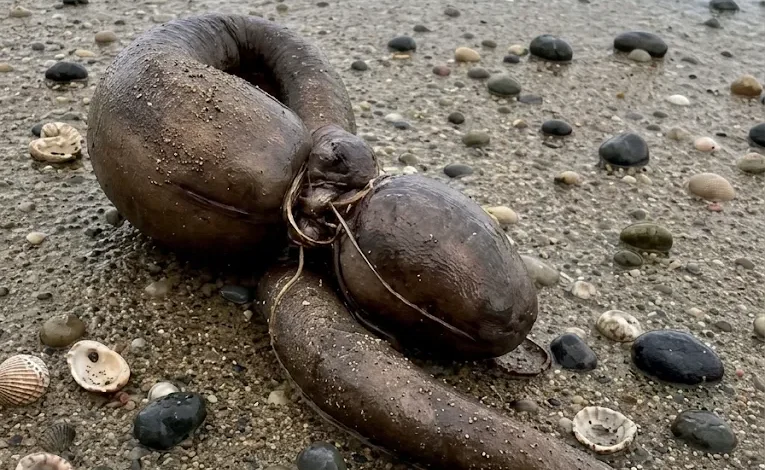
Pet Discovers a Strange Object on the Beach During a Peaceful Walk, Leaving Its Owner Searching for Answers
What was supposed to be a relaxing walk along the shoreline suddenly turned into a puzzling discovery when a pet noticed something unusual lying among the wet stones near the water. The strange object had an unusual shape that immediately attracted the animal’s attention, leaving its owner curious about what could possibly have washed ashore.
At first, it appeared to be just another piece of material carried in by the waves. But when the owner moved closer, the object’s distinctive appearance raised more questions than answers. It did not look like an ordinary seashell, familiar rock, or recognizable piece of driftwood.
What exactly was it, and how long had it been sitting there?
The Pet Notices Something Unusual
According to the account, the discovery happened during an otherwise ordinary walk beside the water. The pet was exploring the shoreline when it suddenly stopped near an unfamiliar object resting between damp pebbles.
Rather than approaching it confidently, the animal reportedly moved closer, sniffed the strange material, and then stepped backward.
Its reaction immediately caught the owner’s attention.
Curious about what had attracted the pet, the owner approached the object for a closer look. From a short distance, its unusual outline was already noticeable. It appeared to have a rounded central section, several curved extensions, and a narrow portion stretching away from the main structure.
The shape was difficult to recognize, particularly because the surface appeared weathered and had apparently been exposed to the elements.
What made the discovery even more interesting was the uncertainty surrounding its origin. There were no obvious identifying labels, markings, or other details that could immediately reveal what it was.
A Shape That Raises More Questions
The object did not seem to match the familiar things people commonly encounter on beaches.
Its rounded center and curved sections gave it an unusual appearance, while the extended portion made it difficult to determine whether it belonged to something natural or manufactured.
Years of exposure to seawater, sand, sunlight, and changing temperatures can dramatically alter the appearance of objects. Materials that once had recognizable shapes can become worn, discolored, and distorted.
This makes beach discoveries particularly challenging to identify.
Something that originally belonged to a piece of equipment might eventually resemble a natural formation. Likewise, unusual marine materials can appear almost artificial when viewed from certain angles.
Without a detailed examination, the object’s unusual outline alone cannot provide a reliable identification.
Could It Have Come From the Ocean?
One possible explanation is that the object was a natural material carried onto the shoreline by waves and currents.
Beaches regularly collect driftwood, marine vegetation, pieces of seaweed, and other organic materials. After spending time in the water, these materials can become twisted, softened, or reshaped.
The movement of sand and stones can also wear away their surfaces, leaving behind unusual forms that may look unfamiliar to anyone discovering them for the first time.
Depending on the location, the object could also have been part of a marine organism or a naturally occurring formation.
However, there is not enough information to confirm that it came from a natural source.
Another Possibility: Something Lost at Sea
A second explanation is that the object was originally manufactured for human use.
Fishing equipment, boating accessories, fragments of marine machinery, and discarded household materials can all find their way into the ocean.
Once submerged, these objects may be exposed to saltwater corrosion, physical damage, and repeated movement against rocks and sand.
Over time, their original appearance can become almost impossible to recognize.
It is also possible that the object was part of a larger item that broke apart before reaching the shore.
Still, without identifying marks, measurements, or a closer inspection, these possibilities remain theories rather than established explanations.
Why Did the Pet React So Cautiously?
One detail that made the discovery particularly memorable was the animal’s reaction.
The pet reportedly approached the object, investigated its smell, and then moved away. To the owner, this behavior made the discovery seem even more mysterious.
However, animals often investigate unfamiliar objects cautiously.
An unusual smell, unfamiliar texture, strange movement, or simply an unexpected shape can cause a pet to hesitate. This does not necessarily mean that the object is poisonous, dangerous, or capable of harming an animal.
Its reaction may simply have reflected curiosity mixed with caution.
Nevertheless, owners should avoid allowing pets to sniff, lick, chew, or play with unidentified beach debris. Some washed-up materials can contain sharp edges, harmful substances, or biological hazards.
The Importance of Not Touching Unknown Beach Discoveries
Although unusual beach discoveries can be fascinating, not every object should be handled.
Some items may contain sharp metal, broken glass, fishing hooks, chemicals, or other potentially dangerous materials. In certain circumstances, unidentified objects could also be connected to damaged equipment or hazardous debris.
The safest approach is to keep a reasonable distance and prevent pets or children from approaching.
If an object appears suspicious, potentially explosive, chemically contaminated, or otherwise hazardous, it should not be touched or moved. Local authorities or the appropriate environmental or coastal safety service should be contacted.
Taking photographs from a safe distance can also help others assess the discovery without unnecessary risk.
Could Photographs Help Solve the Mystery?
A few additional details might make identification much easier.
Clear photographs from several angles could reveal features that are difficult to notice in a single image. Information about the object’s size, weight, texture, and exact location could also help narrow down the possibilities.
For example, visible attachment points might suggest that it once belonged to manufactured equipment. Fibrous or organic textures could point toward natural material, while corrosion patterns might provide clues about prolonged exposure to seawater.
Even then, a photograph may not be enough to establish its identity with certainty.
A proper examination may be necessary, particularly if the object appears potentially hazardous.
An Ordinary Walk Becomes an Unexpected Mystery
What began as a peaceful stroll beside the water became a memorable experience for both the pet and its owner.
The discovery offered a reminder that shorelines are constantly changing environments. Waves, tides, storms, and ocean currents regularly transport materials from places far beyond the beach itself.
Some objects are natural. Others are remnants of human activity. And occasionally, something washes ashore that is difficult to identify without a closer investigation.
For now, the unusual discovery remains unexplained. Its distinctive shape provides a few clues, but not enough to establish where it came from or what purpose it may once have served.
Perhaps it was simply a piece of weathered marine debris. Perhaps it belonged to an object lost at sea. Until more information becomes available, the mystery remains open.
Sometimes, the most unexpected discoveries are waiting in the most familiar places—even along a beach where someone is simply taking their pet for a walk.
Note: The object’s identity and the specific circumstances of the discovery have not been independently verified. The possible explanations above are suggestions, not confirmed identifications.




